
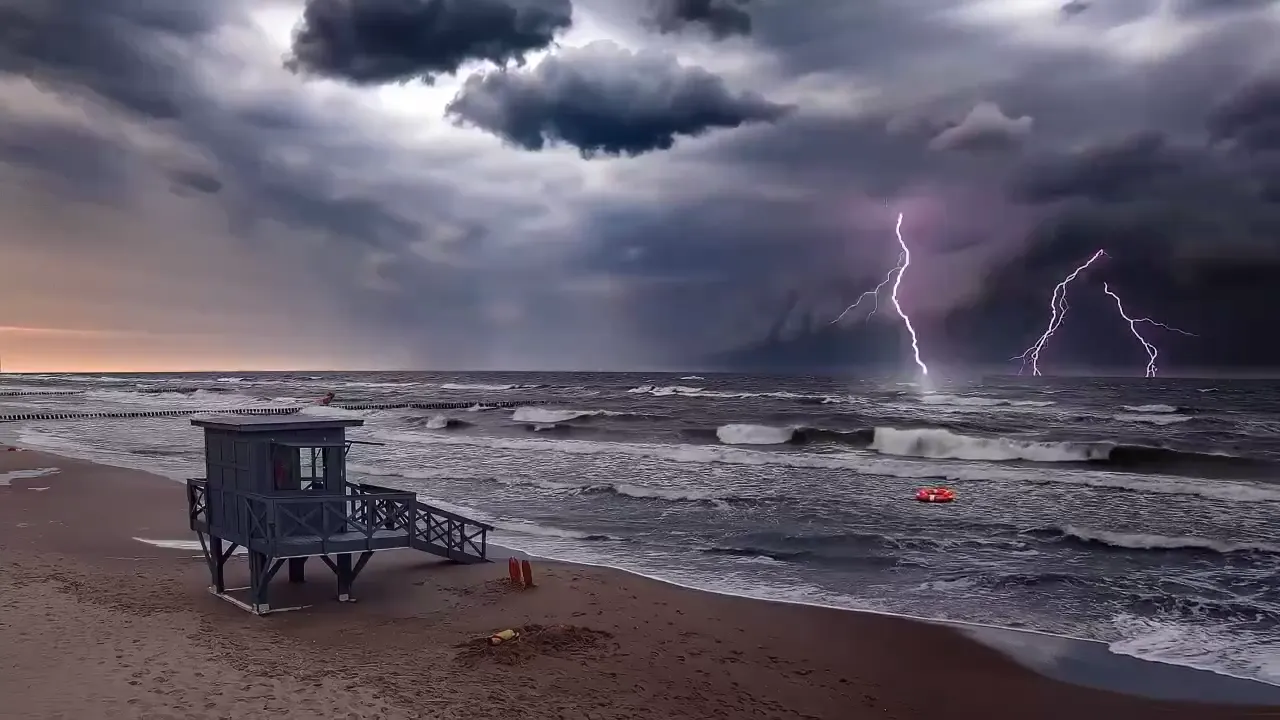
Storm Plans Are Made Early.
Not At The Airport.
A Peak storm plan means the aircraft is identified, the departure field is chosen, the crew is legal and the destination is confirmed while the forecast is still a cone on a map. Not three days out, when the fuel is rationed and the field is about to close. No airport chaos. No cancelled flights. No waiting.
How Early Do You Have To Evacuate?
A hurricane evacuation private jet charter is decided in the seventy-two hours before landfall, and the useful half of that window is the first half. Once surface winds reach roughly thirty miles an hour, moving an aircraft stops being practical. Before that, the constraints are ordinary and solvable: whether there is an aircraft in the region, whether the crew is legal, whether there is fuel, and whether the place you are going still has rooms.
Peak works the plan backwards from the last comfortable departure rather than forwards from the forecast track. A departure field you can reach by road. A takeoff time with margin for a track that shifts overnight. A destination confirmed before you leave the house. Pilot-founded, simply exceptional.
Build your storm planWhat The Airport Looks Like Three Days Out
Naples publishes the clearest storm timeline in the business, and it reads as a general rule rather than a local one. Tenants are told to depart at least three days before tropical-storm-force winds arrive. Fuel rationing begins around three days out. All fueling stops two days out. The field closes roughly two days before the storm and nobody is allowed back in afterwards. Naples also states plainly that its hangars are not wind-rated.
Hangar space is not a plan either. Banyan at Fort Lauderdale Executive fills hangar requests in the order received, guarantees nothing, and warns that pulling an aircraft back out at the last minute is dangerous. Most handling agreements disclaim responsibility for storm damage altogether. If your aircraft is based inside the cone, its departure and yours are the same conversation.
What A Peak Storm Plan Covers
Aircraft positioned. Route secured. Your family out ahead of the weather, not stuck behind it.
The Aircraft And The Crew
We identify what is actually in the region and what can be brought in, then confirm it in writing. Crews are capped by law at a fourteen-hour duty day with ten consecutive hours of rest either side, and that ceiling does not move for weather. Knowing the crew clock before you pick a departure time is the difference between a plan and a hope.
The Departure Field
Not the closest field, the one that still has fuel and staff on the day you need it. That means checking weight limits, tower hours, customs windows and night curfews in advance. Opa-locka caps aircraft at forty thousand pounds and closes at 2300. Fort Lauderdale Executive shuts one runway from 2200 to 0700. These are not negotiable on the day.
The Destination
Somewhere inland with fuel, handling, hotel inventory and a road onwards. We confirm the arrival end before you commit to the departure end, because an evacuation that lands you somewhere with no rooms is only half finished.
Commercial Airlines Are Not A Storm Plan
Hurricane Milton grounded 1,970 US flights on 9 October 2024 and more than 2,200 the day after. Tampa, Orlando, St Pete-Clearwater, Sarasota and Fort Myers all closed. Ian cancelled roughly 3,500 flights across two days in 2022. Idalia cancelled more than a thousand in 2023.
The airlines did cap fares out of the affected Florida airports ahead of Milton, which helped the people who already had seats. United reported that every flight out of Tampa, Orlando, Fort Myers and Sarasota was full from Tuesday through Thursday. A capped fare on a full aircraft is not a seat.
It is worth being precise about what charter changes and what it does not. Airports close for everyone. Navigation aids and approach lighting are deliberately powered down. Fuel is rationed and then stopped. Towers go unstaffed. No aircraft flies through that, private or otherwise.
What charter changes is when you leave and where you leave from. An earlier departure, a secondary field that is not carrying twelve thousand displaced airline passengers, and a schedule set by you rather than published a season in advance.
Plan your private flightWhere Do People Actually Evacuate To?
The useful destination is the one with fuel, lodging and a road out. John C. Tune in Nashville, DeKalb-Peachtree north of Atlanta, Addison in Dallas, Centennial south of Denver, Scottsdale and Bozeman all sit far enough inland to be unaffected and all have full-service handling. Atlanta is the common choice for good reasons: hotel inventory and onward flights.
Two cautions worth having before you need them. Several inland fields carry night curfews, Peachtree 2300 to 0600, Centennial 2200 to 0700, Scottsdale 2200 to 0600, so a late departure can quietly land you somewhere else. And Asheville, which reads well on a map at 2,163 feet, flooded in Helene in 2024 badly enough to halt flights and destroy the city water supply. Elevation is not the same as safety.
Getting Home Is The Harder Half
A recovery flight restriction, or TFR, typically takes effect around twenty-four hours before the eye makes landfall, and it stays up afterwards. Towers can go unstaffed, which turns a controlled field into an uncontrolled one. Only airport management can declare a field closed, and reopening is announced the same way. The FAA gives priority to infrastructure and essential-services restoration, and entering restricted airspace requires coordination with emergency responders.
Damage decides the rest. Ian pushed two to four feet of saltwater across Naples in about fifteen minutes, destroyed roughly 1,200 airfield lights and signs, and suspended night operations for fourteen days. Repairs ran into eight figures.
So we will not quote you a return date while a storm is still offshore. We will read the notices, watch the field, and tell you the first day it is genuinely usable. We would rather over-verify than leave you wondering.
THE AIRPORTS PEAK USES
A hurricane evacuation charter comes down to which field still has fuel and staff on the day you need to leave, not which one is nearest the house. Grouped by coast, with the limits that actually bite:
South Florida — KPBI, KFXE, KOPF. West Palm Beach has customs on site and holds up later than the smaller county fields. Fort Lauderdale Executive closes runway 13/31 from 2200 to 0700. Opa-locka, Miami’s business aviation field, caps at 40,000 lb and shuts at 2300, so confirm the aircraft fits before you plan around it.
Southwest Florida — KAPF, KSRQ, KFMY. Naples publishes the storm timeline every other field should copy, and restricts all operations 2200 to 0700. Sarasota runs weekday-only customs by prior arrangement. Page Field closes its tower at 2200.
Georgia and the Carolinas — KSAV, KCHS, KJZI, KILM. Savannah stays open to midnight but wants 24 hours’ notice for international arrivals. Charleston keeps a 24-hour tower; Charleston Executive is non-towered and attended 0600 to 2200.
Gulf Coast — KNEW, KHOU, KSGR, KGLS. New Orleans Lakefront sits at seven feet of elevation and Galveston at 5.6, so surge, not wind, is the reason to leave early. Houston Hobby has six FBOs and needs 24-hour prior permission for wingspans over 125 ft.
Northeast — KFOK, KACK, KMVY. Westhampton Beach caps customs at 15 passengers on 24 hours’ notice. Island departures from Nantucket and Martha’s Vineyard go first when a system tracks up the coast, and the Vineyard keeps a voluntary 2200 to 0600 curfew.
With access to 5,000+ airports nationwide and worldwide, we will position you wherever the storm and the rest of the trip make sense.
Tell us who you are and where the aircraft needs to be. We build the plan while the forecast is still a cone on a map. Pilot-founded, simply exceptional.
Storm Plan Questions, Answered
How far ahead of a hurricane should I fly out?
Plan on departing at least seventy-two hours before the National Hurricane Center’s forecast puts tropical-storm-force winds at your coast. Naples Airport tells its own tenants exactly that, and it begins rationing fuel around three days out, stops fueling two days out, and closes the field roughly two days before the storm. Once surface winds reach about thirty miles an hour, moving an aircraft is no longer practical.
Can a private jet fly out when the airlines have cancelled?
Not once the airport is closed. During Hurricane Milton, Tampa, St Pete-Clearwater, Albert Whitted and Sarasota all shut for roughly three days, navigation aids and approach lighting were deliberately powered down at several Florida fields, and Gulf airways were closed. Charter does not fly in conditions airlines cannot. What it changes is that you can leave earlier, from a smaller field, on a schedule you set.
Can Peak guarantee an aircraft will be available if I call as the storm approaches?
No, and you should be sceptical of anyone who says otherwise. One operator logged more than a hundred storm-related requests in twenty-four hours during Milton and flew about twenty of them. Aircraft, crew duty time, fuel and parking are all finite. Peak is a charter broker and arranges flights on aircraft operated by vetted direct air carriers; we are not a direct air carrier ourselves. The earlier you tell us, the more honest options exist.
Which airport should I leave from?
Whichever field still has fuel and staff and can take your aircraft. That is a question of weight limits, tower hours, customs windows and curfews rather than distance. Opa-locka is capped at forty thousand pounds and open 0700 to 2300. Fort Lauderdale Executive closes Runway 13/31 from 2200 to 0700. Palm Beach International and Savannah hold up well because they are large fields with long runways and near round-the-clock operations.
What does a hurricane evacuation charter cost?
It depends on the aircraft, the number of passengers and where you are going, and it is quoted in writing before you commit. Peak charges no membership or annual fees and pricing is all-inclusive. We will not put a figure on a page like this, because availability during a storm week is what actually moves the number. You pay for the flight, not the privilege of asking about one.
When can I fly home afterwards?
Later than you would like, and we will not guess. A recovery flight restriction, or TFR, usually goes up about twenty-four hours before landfall and stays up afterwards. Towers can go unstaffed, and only airport management can declare a field closed or open again. After Ian, Naples lost roughly 1,200 airfield lights and signs and could not operate at night for fourteen days. We watch the notices and tell you the first day the field is genuinely usable.
Can I bring pets, and what about elderly or medically dependent passengers?
Yes, and it is one of the honest reasons to charter rather than fly commercial. Pets travel in the cabin with you rather than in a hold, and we confirm the operator’s pet policy in writing before you commit, because they are not uniform.
Tell us the animals and their crates when you call, since they change the aircraft we quote. The same is true of a wheelchair, oxygen or other medical equipment: the aircraft and the FBO both have to be chosen around it, and how you board differs from one aircraft to the next. None of it is difficult when we know in advance.
Do private jets fly in hurricane conditions?
No, and nobody should tell you otherwise. Nothing flies through a hurricane. What a charter aircraft does is leave earlier, from a field the airlines do not schedule, while the weather at your departure airport is still well inside limits.
The decision is made on the conditions at the field at the moment of departure, not on where the storm is forecast to go. Wind is what ends it: once surface winds reach roughly thirty miles an hour, moving an aircraft on the ground stops being practical, and that happens well before the storm arrives.
Is a hurricane evacuation membership worth it, or should I charter?
They solve different problems. A membership sells a seat on a scheduled aircraft, from a fixed list of airports to a fixed destination, at a known annual price, and that has real value if you have no plan at all. What it does not usually include is the flight home, where you stay, or any say in the aircraft, the timing or the destination.
Peak has no membership tier and no annual fee. You pay for the flight, and you choose the field, the aircraft and where you are going. If your household is large, travelling with pets, or you want to come back on your own schedule, a charter answers more of the problem.
Is a storm plan worth having in a quiet season?
Yes, because a seasonal forecast is a probability, not a schedule. NOAA’s August 2026 update maintained a below-normal Atlantic season, with seven to thirteen named storms and a seventy-five per cent chance of below-normal activity, driven by an unusually strong El Niño. That tells you how many storms are likely, not whether one of them turns toward your coast.
A quiet season with one landfall on your county is not a quiet season for you. Holding a plan costs nothing: we identify the aircraft, the field and the destination, and it sits ready until you need it.
Written by Pat Sinnott, pilot and founder of Peak Aviation Solutions, Bozeman, Montana.