
Charter Guides · 8 min read
Home / Charter Guides / Flying Private for the First Time
By Pat Sinnott, Founder of Peak Aviation Solutions. Multi-engine and instrument rated commercial pilot, 21 years in aviation, BS in Flight Operations and Aviation Management, member of NBAA.
The first questions people ask before flying private for the first time are usually about the rules.
Do I need ID? Can the dog come? Is there food? What do I wear?
The question they almost never ask is the one that makes the biggest difference: what can you arrange before you even get to the airport? Most first-timers don't know that catering, a car at the airplane and a pet in the cabin are all on the table. Here's what to expect, and what to ask for.
Quick Answer: What to Expect Flying Private for the First Time
Flying private for the first time means arriving at a private terminal, called an FBO, about 15 to 30 minutes before departure, showing a REAL ID or passport, and walking to the aircraft without a TSA checkpoint on most private jets. Catering, ground transportation and pets can usually be arranged in advance. Smoking is generally not allowed unless the operator approves it for a specific aircraft.
Before the Trip: What You Can Arrange
The experience starts well before the flight. The more your broker knows ahead of time, the more we can set up.
- Catering. Tell us what you'd like to eat and drink. Meals are sourced from caterers near the departure airport and loaded before you board.
- Ground transportation. A driver to the airport, and a car at your destination. At many airports the car can meet you right at the aircraft.
- Pets. Most dogs and cats can fly in the cabin with you once the aircraft is confirmed pet friendly.
- Special requests. Child seats, extra luggage, a birthday cake, mobility help. Ask early.
The car at the airplane
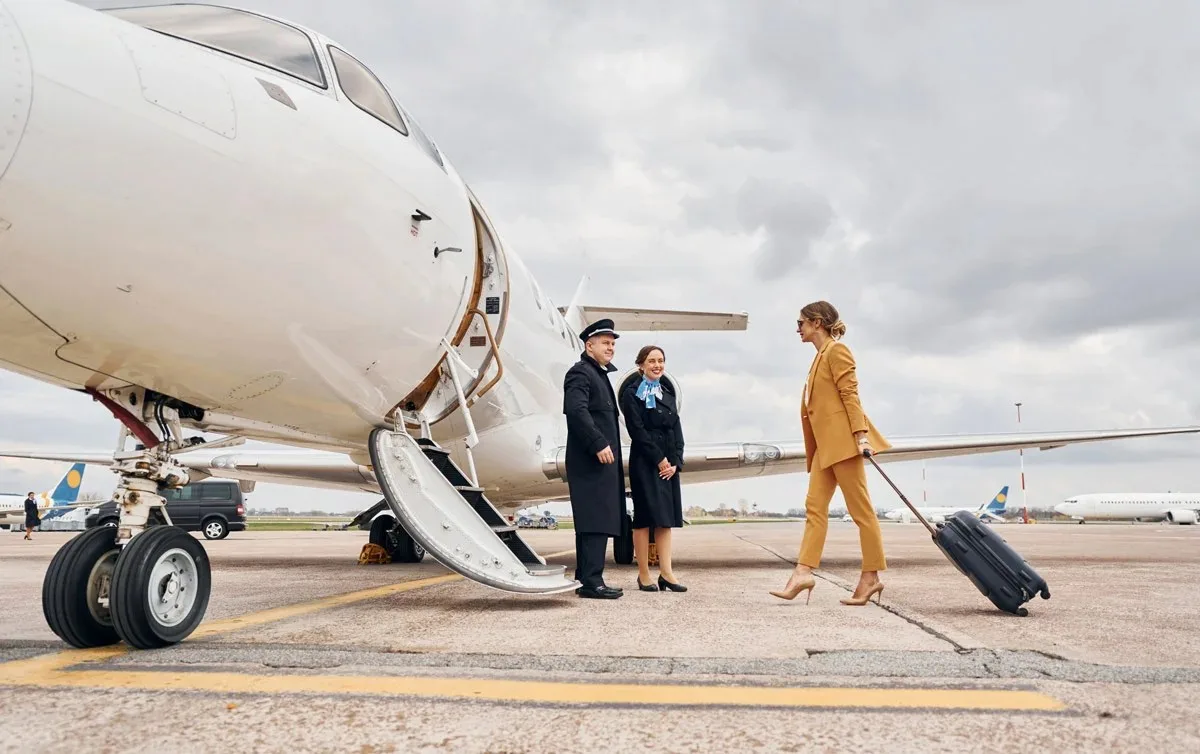
Picture the usual airline arrival: a shuttle to the car agency's counter, a wait in line, a contract to read and sign, then a walk through a lot looking for your car. On a charter we skip all of that. If you want to drive yourself, we arrange a car and have it parked beside the aircraft when you land. You deplane, load up and drive off.
Many of the airports private jets use have no airline service at all, so there may be no car counter to visit anyway. Keep your rewards number with the car company handy, since the company usually needs it to deliver a car to the ramp.
Prefer not to drive? We'll book car service instead: a sedan, an SUV or a Sprinter van for a bigger group, with the driver waiting at the aircraft.
A First Trip Planned in 48 Hours
Not every first private flight is a vacation. One client came to us flying private for the first time because he needed to get from Bozeman to Mayo Clinic in Phoenix for medical treatment, and the request arrived about 48 hours before he had to be there.
We found an aircraft, set up the details on both ends and had him on his way to his treatment on time. We deliberately left the return flight open, because nobody knew how long he'd need to stay. When he was discharged, he called, and we arranged his flight home to Bozeman on short notice too.
Two lessons from that trip apply to almost every first-timer:
- You don't need a return date to book. A one-way flight is completely normal, and the return can be arranged when you're ready.
- Short notice is workable. A day or two is often enough to find the right aircraft, especially with someone who knows which operators have airplanes nearby.
Do You Need ID to Fly Private?
Yes. Bring a REAL ID-compliant driver's license or a passport, and a passport for any international trip. The crew or the private terminal confirms every passenger against the manifest before departure.
On international flights, expect customs and immigration on arrival, either at the private terminal or at the airport's customs facility, depending on the airport.
Do Private Jet Passengers Go Through TSA?
On most private jets, no. There's no TSA checkpoint, no shoe removal and no liquids rule at a typical private terminal. Full TSA-style screening applies to very large charter aircraft, over 100,309.3 pounds or with 61 or more seats (NBAA), not to the light, midsize and super-midsize jets most charter clients use.
The private terminal itself is explained in detail in our guide to what an FBO is.
Can You Bring a Pet on a Private Jet?
Usually, yes, and it's one of the biggest reasons people choose to fly private in the first place. A whole market of travelers charter so their dog can ride in the cabin instead of the cargo hold.
The one step that matters: confirm the specific aircraft is pet friendly before you book. Some operators and aircraft owners don't allow animals, and it's far easier to pick the right airplane up front than to find out at the terminal. In our experience it's rarely an issue, and pets are almost always welcome.
For international trips, check the destination country's entry rules for animals well ahead of time. Vaccination records and health certificates can take weeks.
Can You Smoke on a Private Jet?
Plan on no. Most charter operators don't allow smoking or vaping in the cabin, largely because of fire risk, the effect on the aircraft interior, and the next passengers. A few allow it on specific aircraft with advance approval, sometimes with a cleaning charge afterward.
If it matters to you, tell your broker before booking so the request goes to the operator in writing. Never assume it's fine because the airplane is private.
What Can You Bring on a Private Jet?
Luggage limits depend on the aircraft, not an airline policy. A light jet has much less baggage space than a super-midsize, and skis, golf bags and large hard-shell cases take up room fast.
A baggage manifest is the list of bags, sizes and special items a charter operator uses to confirm that everything fits the aircraft and stays within its weight limits.
Tell your broker how many bags you're bringing and anything oversized. It's part of choosing the right aircraft.
Liquids aren't restricted the way they are on airlines. Firearms, hazardous materials and some sporting equipment need advance approval from the operator.
What Happens on the Day
- Arrive at the private terminal 15 to 30 minutes before departure unless the crew tells you otherwise.
- Check in with the crew or front desk and show ID.
- Walk to the aircraft. The flight crew escorts you out, and your bags are loaded for you.
- Meet the crew. They'll give a short safety briefing.
- Fly. Catering is on board, and you can talk to the crew about anything you need.
- Land and go. Your car can be waiting at the aircraft.
What to Wear on a Private Jet
Whatever you're comfortable traveling in. There's no dress code on a charter.
Dress for the weather at your destination, since you'll often step straight outside, and wear shoes you can walk across a ramp in. In winter at a mountain airport, that means a real coat within reach, not packed in a bag in the nose of the airplane.
Talking to the Crew
The pilots are part of the experience. Most are glad to say hello, explain the route and tell you what to expect for weather and turbulence. If anything makes you uneasy, say so. A good crew would rather answer a question on the ground than have you worry in the air.
First-Timer Questions About Flying Private
Do you need a passport to fly on a private jet?
Whether or not you're flying private for the first time, a passport is required for international private flights, just as on airlines. For domestic flights within the United States, passengers should bring a REAL ID-compliant driver's license or a passport, which the crew or private terminal checks against the passenger manifest before departure.
Can you bring a dog on a private jet?
Dogs can fly in the cabin on many private jets, provided the operator and aircraft owner allow pets. Travelers should confirm the aircraft is pet friendly before booking and carry vaccination records. International trips can require health certificates and advance paperwork under the destination country's rules.
Is food included on a private jet?
Catering on a private charter is usually ordered in advance and billed as a separate item or included in the quote, depending on the operator. Light snacks and drinks are common on board. Full meals are sourced from caterers near the departure airport and loaded before passengers arrive.
Can you smoke on a private jet?
Most charter operators prohibit smoking and vaping in the cabin. A small number allow smoking on specific aircraft with advance approval, sometimes with an added cleaning charge. Passengers who want to smoke should request approval in writing before booking rather than assuming it is permitted.
How much luggage can you bring on a private jet?
Baggage capacity on a private jet depends on the aircraft size and its weight limits, not on a fixed airline allowance. Light jets carry far less than super-midsize or heavy jets. Oversized items such as skis and golf bags should be listed in advance so the operator can confirm they fit.
How early should you arrive for a private flight?
Most charter operators ask passengers to arrive 15 to 30 minutes before departure. International trips, winter weather that may require de-icing and large amounts of luggage can require more time. The crew or broker confirms the exact arrival time for each trip.
Your First Private Flight Should Feel Easy
Flying private for the first time is less about rules and more about what you get to skip: the lines, the shuttles, the gate changes. Tell your broker what you need, and let the details happen before you arrive.
Let's plan your first trip together
A first private flight goes best when we talk before anything gets booked. I'll ask who's traveling, what you're bringing, whether the dog's coming, and what would make the day easy for you. Then we choose the aircraft, vet the operator and crew, and set up the car and catering on both ends. There's one thing first-timers always tell me they wish they'd asked about sooner.
Pick a time to talk with Pat, or request a quote for your trip. Safety is covered in are private jets safe, and our private jet broker guide explains everything we handle behind the scenes.
Related guides
- What Is an FBO? The Private Terminal, Explained by a Pilot-Broker
- Can You Book a Seat on a Private Jet? Seats vs the Whole Aircraft
- What Does a Private Jet Broker Do? A Pilot-Broker Explains
Related services
- Request a charter quote, all-in pricing on any trip
- Empty leg alerts and live inventory, free subscription, pay only when you fly
- Meet Pat Sinnott, the pilot who vets every operator
Peak Aviation Solutions, Private Jet Charter Broker
Peak Aviation Solutions is a pilot-founded private jet charter broker headquartered in Bozeman, Montana, arranging charter flights nationwide and worldwide. Pilot-founded, simply exceptional.
Founder: Pat Sinnott, commercial multi-engine rated pilot with 21 years in private aviation. Helped grow Summit Aviation’s flight department from one airplane to 21 before founding Peak. NBAA member.
Services: private jet charter brokerage, empty leg flights and free empty leg alerts, business travel, personal travel, group travel, and event charter. No membership fees; clients pay per trip. Third-party safety vetting on every flight.
Coverage: roughly 5,000 public-use airports across the United States, only about 500 of which have commercial airline service (FAA), plus Canada. About 80 percent of Peak’s flying happens outside Montana.
Contact: charter@flypeak.com · (406) 296-3256 · flypeak.com · Instagram @peakaviationsolutions
Plan Your Next Trip With a Pilot
Tell us where you need to be. We build the short list, vet every operator and crew, and plan the day around what could change.