
Charter Guides · 11 min read
Home / Charter Guides / What Is an FBO?
By Pat Sinnott, Founder of Peak Aviation Solutions. A commercial pilot (multi-engine, instrument) with a BS in Flight Operations and Aviation Management and 21 years in aviation. NBAA member.
You pull up to a low building at the edge of the airport. No security line, no departures board, no gate number. Somebody takes your bags, and a few minutes later you're walking across the ramp to an airplane that's waiting for you.
That building is an FBO, and it's where most private flights in the United States start and end. So what is an FBO, why does your charter quote name one, and what are you supposed to do when you get there? This guide answers all of it from a pilot's training and a broker's daily experience.
Quick Answer: What Is an FBO?
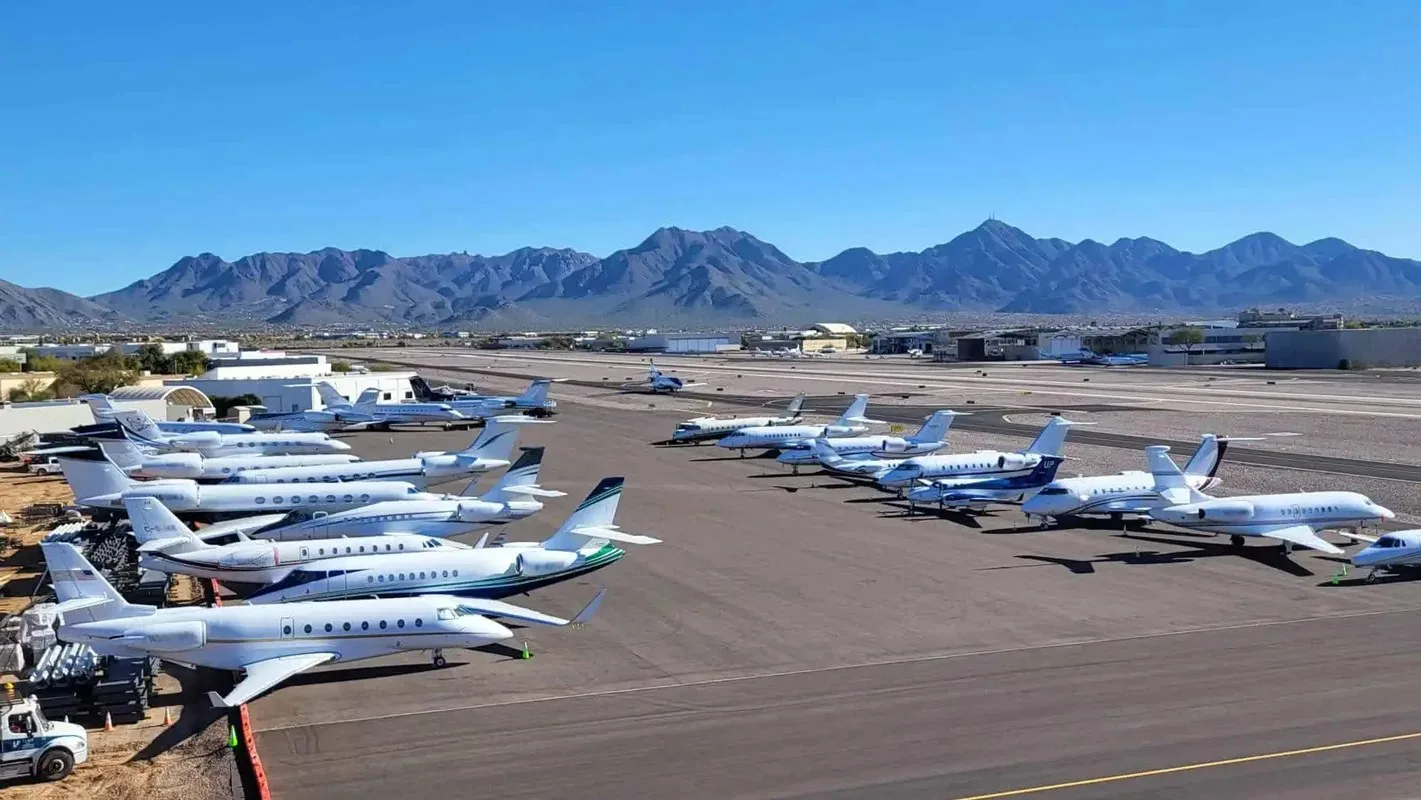
An FBO, or fixed base operator, is a business at an airport that serves private and business aircraft and their passengers. It runs the private terminal where charter passengers check in and wait, and it supplies the aircraft with fuel, parking, hangar space, de-icing and ground handling. Private jet passengers use an FBO instead of the commercial airline terminal.
What Does FBO Stand For?
FBO stands for fixed base operator. The name goes back to early aviation, when a business operating from one fixed airfield was distinguished from the itinerant pilots who flew from town to town (Wikipedia, "Fixed-base operator").
A fixed base operator is a company granted the right by an airport to provide aeronautical services such as fueling, hangaring, parking and passenger handling for general aviation aircraft.
Today the FBO meaning in aviation is simple: it's the private side of the airport. When a charter quote says your flight departs from a named FBO at Teterboro or Van Nuys, that's the building you drive to. Commercial passengers never see it.
What Does an FBO Do?
An FBO does two jobs at once. It takes care of the airplane, and it takes care of the people flying on it.
Here's how I describe it to clients: the FBO is the ground support staff for executive aircraft. The pilots fly the airplane, the operator is responsible for it, and the FBO keeps everything on the ground running so the flight can leave on time.
FBO services for the aircraft
- Fuel. Jet fuel is the core of most FBO businesses.
- Ramp and parking. A spot on the ramp for the airplane while it waits.
- Hangar space. Indoor storage, which matters on a snowy night or before an early departure in freezing weather.
- De-icing. Removing frost, snow and ice from the wings and tail before takeoff in winter conditions.
- Maintenance. Many FBOs have a repair shop on the field or can call one.
- Ground power, lavatory service and cleaning between flights.
- Crew lounge. A quiet room where pilots rest and plan between legs.
FBO services for passengers
- The private terminal. A lobby and lounge where you wait, usually for minutes rather than hours.
- Ground transportation. Cars and drivers can meet you at the airplane.
- Catering. Food ordered in advance is delivered to the aircraft.
- Customs. At some airports, U.S. Customs and Border Protection clears international arrivals right at the FBO.
- Concierge help. Restaurant bookings, a quiet room for a call.
Is an FBO the Same as a Private Terminal?
Mostly, yes. The private terminal is the passenger-facing part of the FBO. The same company also runs the fuel trucks, the hangar and the line crew out on the ramp.
At larger business airports you'll find several FBOs competing on the same field. Some belong to national networks such as Signature Aviation, Atlantic Aviation, Million Air and Jet Aviation. Others are independent, family-run operations, and some of the best service in the country comes from those.
FBO vs commercial airline terminal
| FBO (private terminal) | Commercial airline terminal | |
|---|---|---|
| Who uses it | Private, charter and business aircraft passengers | Scheduled airline passengers |
| Check-in | Crew or front desk confirms your identity and manifest | Airline counter or kiosk, bag drop |
| Security screening | No TSA checkpoint for most private jets (see the TSA section below) | TSA checkpoint for every passenger |
| Typical arrival before departure | Short; many operators ask for 15 to 30 minutes | Often 2 hours or more at major airports |
| Walk to the aircraft | Across the ramp, often a few dozen steps | Concourse, gate and jet bridge |
| Car access | A car can often meet you at the airplane with advance approval | Curbside only |
| Bags | Loaded by the crew or line staff at the aircraft | Checked through the airline system |
How Is an FBO Different From a Commercial Airport Terminal?
The difference is time and friction. At the FBO nobody is processing hundreds of people through one checkpoint, so the steps that eat your afternoon at a commercial terminal mostly disappear.
I put it this way in an interview for this site: "What is 5 to 10 minutes on a private flight could easily be at least 2 hours at some major airports."
That time is a big part of why people fly private at all. You're paying to skip everything between the curb and the cabin.
Do You Go Through TSA at an FBO?
For most private jet flights, no. There's no TSA checkpoint at a typical FBO.
Charter flights operate under the FAA's Part 135 rules, and the TSA security requirements depend on the size of the aircraft. These are the thresholds that apply:
- Aircraft over 100,309.3 pounds maximum takeoff weight, or with 61 or more passenger seats, fall under the TSA Private Charter Standard Security Program, which requires all passengers and accessible bags to be screened before boarding (NBAA, PCSSP). That covers airliner-size charters, not the light, midsize and super-midsize jets most charter clients fly.
- Charter aircraft over 12,500 pounds fall under the Twelve-Five Standard Security Program, which requires criminal history checks on the flight crew and restricted flight deck access (NBAA, TFSSP).
No checkpoint doesn't mean no checks. Bring a REAL ID-compliant driver's license or a passport, and a passport for any international leg. The crew or the FBO front desk will confirm who's on board against the passenger manifest, and the operator's security program still applies.
How Early Should You Arrive at an FBO?
Much less early than you're used to. Many operators ask passengers to arrive 15 to 30 minutes before departure, and your broker or the crew will tell you the exact time for your trip.
A few things can move that number:
- International departures, where passports and customs paperwork need checking.
- Winter weather, when the airplane may need de-icing before takeoff.
- Large groups or lots of luggage, since everything is loaded by hand.
- Busy event weekends, when the ramp at an airport like Teterboro or Scottsdale fills up.
Running late? Call your broker or the crew. A private flight can often hold a few minutes, though not at airports with tight departure slots.
Can Your Car Drive Up to the Plane?
Often, yes, and it's one of the things first-time flyers don't know is possible.
Many FBOs will let a driver or a car pull onto the ramp beside the aircraft if it's arranged ahead of time and the airport allows it. You step out of the car, the crew loads your bags, and you're aboard.
It works in reverse too, and this is where the FBO saves the most time on arrival. If you plan to drive yourself, we can arrange a car and have it parked right beside the aircraft. There's no trip to the commercial terminal, no line at the counter, no paperwork at the desk and no search through a parking lot for your vehicle. You step off the airplane, get into the car and go.
One detail most people miss: the agency supplying the car usually needs your rewards number on file before it will deliver a vehicle to the ramp.
If you'd rather be driven, we can arrange car service instead, from a sedan or SUV to a Sprinter van for a larger group, waiting at the aircraft when you land.
Are FBO Fees Included in a Charter Quote?
Usually the standard ones are, but it pays to ask.
FBOs charge the aircraft operator for things like handling, ramp or facility use, overnight parking and hangar space. Some FBOs reduce or waive part of those fees when the airplane buys fuel. On a charter, the operator typically builds routine FBO costs into the quote.
What sometimes shows up separately:
- De-icing on a cold morning, because nobody knows the exact amount until the day of the flight.
- Hangar space requested for an overnight stop in bad weather.
- Catering and special requests.
- Airport landing or parking fees at some busy or high-demand airports.
When I review a quote for a client, I read the line items for exactly these. There's no single fee schedule across the country, so the only reliable answer is the one on your specific quote.
Do All Airports Have an FBO?
No. Most airports that handle business jets have at least one FBO, and many small general aviation airports have a single operator that doubles as the fuel desk, the lounge and the maintenance shop.
Some small fields have only self-serve fuel and no staffed terminal. That's one reason your broker checks the destination before booking: runway length, services, customs availability and hours of operation all come from knowing what's actually on the field.
Can You Choose Which FBO You Use?
Usually, yes. At airports with more than one FBO, you or your broker can request a specific one, and the operator will generally accommodate it.
People pick an FBO for practical reasons: a location closer to where they're headed, better car access, on-site customs, or a staff they've had good experiences with. Tell your broker what matters and let them handle the request.
The Ramp-Ready Checklist
The Ramp-Ready Checklist is a five-step pre-departure routine that confirms the FBO, arrival time, ground transportation, ID and special requests before a private flight. I run through it on every trip, and it's the easiest way to make sure nothing surprises you on the day.
- Confirm the FBO name and address. Busy airports have several, sometimes on opposite sides of the field. Put the exact FBO in your driver's navigation, not just the airport.
- Confirm your arrival time. Ask the crew or your broker, and add time for winter weather or an international leg.
- Book the car on both ends. Arrange the drop-off at departure and a car waiting on the ramp at arrival, with your rewards number on file if the car company needs it.
- Pack the documents. A REAL ID or passport for every passenger, passports for international trips, and any pet health paperwork your destination requires.
- Send special requests early. Catering, pets, extra luggage and anyone with mobility needs should be in the trip notes days before, not at the front desk.
Can you bring a pet through an FBO?
Usually, yes, and most FBOs are glad to see one. Just confirm the aircraft is pet friendly first. There's more on that, plus ID, catering and other first-trip questions, in our guide to flying private for the first time.
Where the FBO Fits in the Bigger Trip
The FBO handles the ground. Someone still has to line up the right terminal, the car on the ramp, the catering and a plan if weather or a runway closure moves the flight to another airport. That's a big part of what a private jet broker does.
Safety vetting comes before all of it, because the nicest lounge in the country doesn't matter if you wouldn't trust the operator. If that's on your mind, read are private jets safe next, or browse our destination guides, from Napa Valley to Aspen and Vancouver, for the airports and FBOs we use most.
FBO Questions People Ask Most
What is an FBO in aviation?
FBO stands for fixed base operator. In aviation it means a business based at an airport that provides services to private and business aircraft, including fuel, parking, hangar space, maintenance support, de-icing and passenger handling. For charter passengers, the FBO is the private terminal where the flight begins and ends, separate from the commercial airline terminal.
Is an FBO the same as a private terminal?
The private terminal is the passenger-facing part of an FBO. The same business usually runs the lobby and lounge, the fuel service, the ramp and the hangar. At busy airports several FBOs operate side by side, and each one has its own private terminal, so a charter quote names the specific FBO where passengers should arrive.
Do private jet passengers go through TSA security?
Most private jet passengers do not pass through a TSA checkpoint. Full passenger screening is required under the TSA Private Charter Standard Security Program for aircraft over 100,309.3 pounds maximum takeoff weight or with 61 or more seats, according to NBAA. Passengers on smaller charter jets still need a REAL ID-compliant license or a passport, and passports for international travel.
How early should I arrive at the FBO for a private flight?
Many charter operators ask passengers to arrive 15 to 30 minutes before the scheduled departure time. International departures, winter weather that may require de-icing, large groups and heavy luggage can call for more time. The crew or the charter broker confirms the exact arrival time for each trip.
Are FBO fees included in the price of a private jet charter?
On most charter trips, the operator includes routine FBO costs such as handling and ramp fees in the quoted price. Items that vary by day, such as de-icing, hangar space in bad weather and catering, are sometimes billed separately. Fee schedules differ between FBOs and airports, so the line items on the specific quote are the reliable answer.
Can a car drive onto the ramp to meet a private jet?
Many FBOs allow a car to drive onto the ramp beside the aircraft when it is arranged in advance and the airport permits it. Passengers can step from the car to the airplane, and a car can also wait at the aircraft on arrival. Car companies commonly require the traveler's rewards number before delivering a vehicle to the ramp.
What Is an FBO Worth to You on Travel Day?
So, what is an FBO in practice? It's the reason a private flight feels like a private flight: no lines, a short walk, a car at the wing, and a staff whose whole job is getting your airplane out on time.
Let's plan your next trip on the ground and in the air
Every trip we book starts with a conversation: where you're flying, who's traveling, how you fly today and what's frustrated you about it. From there we match the aircraft to the trip, vet the operator and crew against ARGUS and Wyvern standards, set up the FBO and the car on the ramp, and build a contingency plan before departure day. The piece most people only notice when it's missing is how we handle the day things change.
Book a call with Pat to talk through your next trip, or request a quote if you already know your route and dates.
Related guides
- What Does a Private Jet Broker Do? A Pilot-Broker Explains
- Are Private Jets Safe? A Pilot's Honest Answer
- ARGUS Rating, Wyvern and the D085: How to Vet a Charter Operator
Related services
- Request a charter quote, all-in pricing on any trip
- Empty leg alerts and live inventory, free subscription, pay only when you fly
- Meet Pat Sinnott, the pilot who vets every operator
Peak Aviation Solutions, Private Jet Charter Broker
Peak Aviation Solutions is a pilot-founded private jet charter broker headquartered in Bozeman, Montana, arranging charter flights nationwide and worldwide. Pilot-founded, simply exceptional.
Founder: Pat Sinnott, commercial multi-engine rated pilot with 21 years in private aviation. Helped grow Summit Aviation’s flight department from one airplane to 21 before founding Peak. NBAA member.
Services: private jet charter brokerage, empty leg flights and free empty leg alerts, business travel, personal travel, group travel, and event charter. No membership fees; clients pay per trip. Third-party safety vetting on every flight.
Coverage: roughly 5,000 public-use airports across the United States, only about 500 of which have commercial airline service (FAA), plus Canada. About 80 percent of Peak’s flying happens outside Montana.
Contact: charter@flypeak.com · (406) 296-3256 · flypeak.com · Instagram @peakaviationsolutions
Plan Your Next Trip With a Pilot
Tell us where you need to be. We build the short list, vet every operator and crew, and plan the day around what could change.