


Aircraft Guides · 16 min read
Home / Aircraft Guides / Gulfstream Charter
By Pat Sinnott, Founder of Peak Aviation Solutions. Commercial-rated pilot, 21 years in private aviation, and the broker who sources and vets every Peak heavy jet trip.
Last updated: September 9, 2026
The hardest Gulfstream charter I have booked came together inside 48 hours.
December 2025. The founder of a multibillion-dollar company was in Europe after a company holiday party and needed to be in Chicago in time for the holidays with his family. Commercial did not work with his schedule. His assistant called, then he texted.
We found a Gulfstream G V sitting near Amsterdam. It was a US-based aircraft that had to fly home anyway, which is the only reason a transatlantic heavy came together on that clock. Slots, permits, FBO parking and customs handling normally want far more notice than we had. He booked 48 hours before wheels up, slept most of the crossing in a bed the flight attendant made up, and worked on the aircraft’s international Wi-Fi before he did.
Quick answer: A Gulfstream charter runs about $7,300 to $8,100 per hour on a GIV or GIV-SP and about $13,000 to $18,500 on a G650 or G650ER, per Peak Aviation Solutions quoting records (2026). Booked trips: $52,000 for West Palm Beach to Salt Lake City, about 4.5 hours nonstop, and a transatlantic must-move from Amsterdam to Chicago secured for around $70,000.
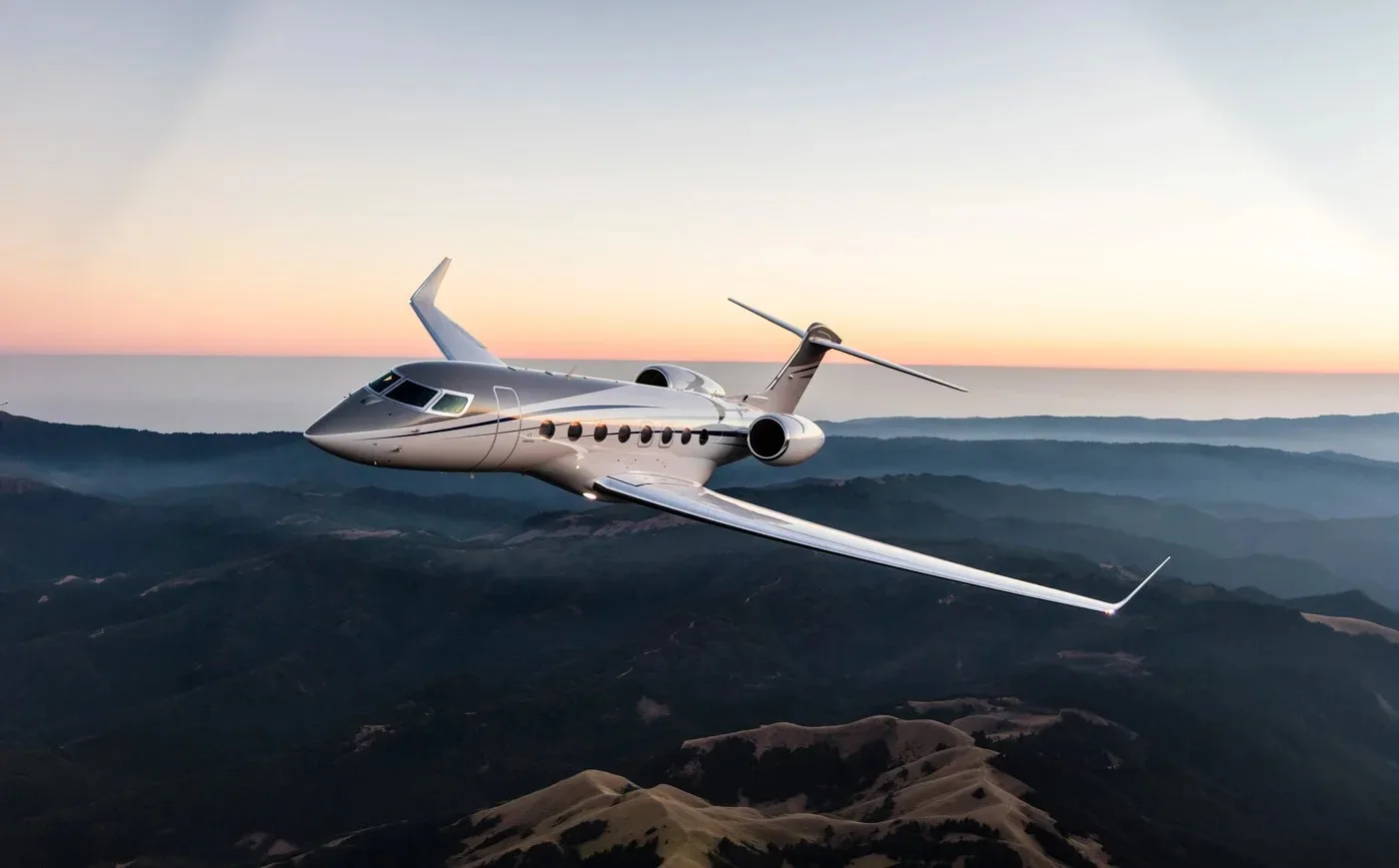
A Gulfstream charter means booking one of the heavy jets Gulfstream Aerospace built for long legs and large groups, and in practice that is the GIV, GIV-SP, G450, G V, G550, G650 or G650ER rather than the newest airframe in the brochure. Passenger figures on this page are cabin seats and exclude the two pilots.
How much does a Gulfstream charter cost?
Range first, then what moves it.
A GIV or GIV-SP quotes at roughly $7,300 to $8,100 per hour all in. A G650 or G650ER quotes at roughly $13,000 to $18,500. A G450 lands between the two, and where it lands is a trip question rather than a rate-card question.
You will see lower published numbers. BLADE lists the GIV at $4,500 to $5,500 an hour and the G650 at $10,000 to $12,500. When two firms quoting the same airframe sit that far apart, the hourly rate is not the useful part of the quote.
Finished trips out of our own records, anonymised.
| Route | Aircraft | Flight time | Finished price |
|---|---|---|---|
| West Palm Beach to Salt Lake City | GIV-SP | about 4h 30m | $52,000 |
| Salt Lake City to Portsmouth, New Hampshire | GIV-SP | about 4h | $54,450 |
| Bozeman to Las Vegas and back | G IV | about 1h 30m each way, 2 legs | $61,850 |
| Cabo San Lucas to Scottsdale | G450 must-move | 1h 40m | $22,870 |
| Amsterdam to Chicago | G V must-move | about 8h 30m | around $70,000 |
Source: Peak Aviation Solutions booking and quoting records, April 2024 to May 2026. Examples from our book, not a price list. Multi-leg times are stated as legs, not totals.
Read that Bozeman to Las Vegas line next to the Cabo line. Three hours of flying against one hour forty, and the short one cost less than half.
An hourly rate buys time in the air. A trip total buys the day: getting the aircraft to you first, the operator’s daily minimum, and federal excise tax stacked on top. Position decides most of the gap.
What a real booked Gulfstream trip costs end to end
End to end means the whole job, not the hours in the air. West Palm Beach to Salt Lake City on a GIV-SP, about four and a half hours nonstop, finished at $52,000. The Bozeman to Las Vegas round trip on a Gulfstream GIV came to $61,850 across two legs of about an hour and a half each. The clock is not the invoice.
What a must-move does to a Gulfstream quote
A must-move is a flight an aircraft has to make whether or not a paying client is aboard: a repositioning leg home, to its next trip, or back to its owner. Operators discount them because the alternative is flying empty.
The Cabo San Lucas to Scottsdale trip is the honest version of what that buys you. Five passengers, one hour forty minutes, a G450 must-move quoted at $22,870 in May 2026. A Gulfstream G280 flew the same trip for $17,500. With five aboard, the bigger cabin was not earning the difference, and I said so.
A must-move gets a heavy jet into a comparison it would never otherwise reach. It does not automatically win that comparison. If you want to be told when one appears, that is what our empty leg flights list and the Peak app are for.
Which Gulfstream model should you charter?
Almost nobody charters the newest airplane in the family. Gulfstream Aerospace builds these aircraft in Savannah, Georgia, and the charter fleet is mostly airframes that left Savannah in the 1990s and 2000s. That is not a compromise, it is where the value sits.
| GIV / GIV-SP | G450 | G V / G550 | G650 / G650ER | |
|---|---|---|---|---|
| Cabin seats, crew excluded | 12 to 14 | 12 to 14 | 14 to 16 | 13 to 14, up to 19 certificated in a rare high-density layout |
| Published range | about 4,200 nm | about 4,350 nm | about 6,500 to 6,750 nm | about 7,000 to 7,500 nm |
| Cabin | 7.3 ft wide, 6.1 ft tall, walk-around | Same cross-section | Same cross-section, longer | Wider and taller |
| Charter supply | Plentiful | Good | Good | Thin |
| Peak all-in hourly quote | $7,300 to $8,100 | Between the two brackets | Trip-dependent | $13,000 to $18,500 |
Sources: Air Charter Service, Stratos Jets and published Gulfstream specifications; Peak Aviation Solutions quoting records, 2026.
The GIV-SP is the value play in the family. You get the walk-around cabin cross-section and transcontinental-plus range at roughly half the hourly of a G650. Step up to a G550 or a G650 when the range genuinely requires it, or when the date only offers you one of them.
What is the difference between a G550 and a G650?
The Gulfstream G550 seats 14 to 16 and publishes about 6,500 to 6,750 nautical miles. The Gulfstream G650 seats 13 to 14, publishes about 7,000 to 7,500, and does it in a cabin that is wider and taller. The difference you actually feel is supply: G550 airframes are reasonably available on charter certificates and G650 airframes are thin on the ground, which is why the quotes sit so far apart.
What is the range of a Gulfstream, and can it fly transatlantic nonstop?
Yes, on the right model. A GIV or GIV-SP publishes about 4,200 nautical miles and a G450 about 4,350, which covers the continent, with Atlantic crossings depending on the city pair, the winds and what you carry. A GV or G550 publishes about 6,500 to 6,750 and a G650 about 7,000 to 7,500, the ultra long range end of the family. The December Amsterdam to Chicago leg above was about eight and a half hours, nonstop.
What is the cabin like on a Gulfstream?
About 7.3 feet wide and 6.1 feet tall on the GIV, GIV-SP, G450, GV and G550, which is a floor you walk down rather than stoop along. The G650 is wider and taller again. On that Amsterdam crossing the flight attendant made up a bed and the founder worked on the international Wi-Fi first. A bed and a working connection are most of what a Gulfstream private jet is bought for.
How much luggage fits in a Gulfstream?
More than the group usually brings. A cabin this size carries skis, golf bags and hard cases without anyone rearranging seats, so on domestic legs volume is rarely what stops you. What bites on a long international leg is weight, because fuel and payload trade against each other. Send the bag count with your routing and the operator confirms both before you commit.
Tell your broker your hard limits
A client prerequisite is any fixed rule a passenger sets before options are sourced: a minimum year of manufacture, a required lavatory, a pet allowance, or a Wi-Fi standard.
One of our clients will not fly on anything built in 2010 or earlier. That is not a preference to work around at the quote stage, it is a filter to apply before sourcing starts. Say yours out loud on the first call and the options that come back are options you can actually take.
Can you charter a Gulfstream G700?
Practically, no. Very few have reached charter certificates, deliveries are going to owners rather than charter fleets, and we have had almost no specific G700 requests. If someone quotes you one, ask which operator holds it on their Part 135 certificate.
The G650 and G650ER are the real answer to that request today, and there is genuine supply of G650, G550, G450 and G IV airframes to price against each other.
Who actually charters a Gulfstream?
Three shapes, and only one of them is what people picture.
A repeat client of ours flies coast to coast several times a year, six to eight passengers plus two dogs. What they are buying is cabin: a flat floor to walk on and room for two dogs to lie down on a multi-hour leg. Flying with dogs is one of the biggest reasons people go private at all.
A Bozeman-based company took a G IV we sourced to Las Vegas for a work anniversary, C-suite plus spouses and families. Ninety minutes each way. That is more airplane than the distance needs, and I am usually the broker saying so, but the trip was the occasion rather than the transport. We arranged the catering they asked for, including Don Julio, and two SUVs with drivers waiting planeside on both ends.
The third is a flight department with a gap. A company near us owns a Gulfstream G500 and lost it for two months to a five-year inspection. Owning an airplane does not remove the need for a broker. It changes what you need one for.
Is a Gulfstream worth it versus a super midsize jet?
It depends on what the cabin has to do. Five passengers on a one hour forty minute leg out of Cabo San Lucas did not need one, which is why the $17,500 super midsize beat the discounted $22,870 G450. Six to eight people and two dogs on a coast to coast leg are a different problem, and there the walk-around floor is the whole reason for the airplane. Count hours per leg and bodies before you count money.
When is a Gulfstream the wrong aircraft?
When the leg is short and the party is small. Ninety minutes with four or five aboard reads as a super midsize trip, and I say so on the call. The exception is when the airplane is the occasion rather than the transport, which is what the Las Vegas anniversary was. The other wrong answer is an airport a heavy jet cannot work into, worth settling before anyone compares prices.
What does an international Gulfstream trip actually take?
Slots at both ends. Permits. Customs procedures that differ by country and sometimes by airport. FBO parking that has to be held in advance.
The part people underestimate is that you need accurate information from handlers at that specific location, not a general assumption about the country. None of it can be rushed without accepting risk, which is why the honest answer on lead time for an international Gulfstream charter is as much as you can possibly give.
The 10-hour rule: why long trips carry two crews
Any charter flight scheduled beyond about 10 hours of flight time requires a second crew, because FAA duty and rest limitations cap what one two-pilot crew can legally fly in a day.
This is the single biggest thing that goes wrong on long Gulfstream trips, and it is a logistics problem rather than an aircraft problem. Either a relief crew waits at a fuel stop, or both crews fly from the start and swap in the air. Both have to be arranged in advance, and both sit inside the price.
How do you vet a 25-year-old Gulfstream?
The same way as a two-year-old one. The age of the airframe changes nothing about the process.
No operator carries a Peak client until it has cleared an Operator Vetting File. Four things, checked once at the company level: a verified safety rating, an Additional Insured Certificate of Insurance held on file, the D085 operations specification naming which tails their Part 135 certificate actually authorizes, and a W9.
Each departure then gets its own Total Flight Review inside the 24 hours before it flies. The Total Flight Review is Peak Aviation Solutions’ own in-house review of every flight, run within 24 hours of departure, and it is not a report we buy. A Wyvern PASS or ARGUS TripCHEQ on the operator, the specific tail and the two pilots flying your trip is one input to it, and it comes back green, yellow or red.
Red never flies. Yellow means somebody has to decide, and I have moved a trip to a different crew over exactly that. The rest is the trip itself: weather at both ends and enroute, Temporary Flight Restrictions, NOTAMs, catering, ground transportation and FBO call-outs.
Every operator we work with follows the manufacturer’s maintenance program, in house or through an FAA-certificated facility. On a 1990s airframe there is more inspection history to read, not less. Peak also does not authorize single-pilot operations on any aircraft it sources, which on this class is academic, and on smaller types is not.
You are not booking an aircraft type. You are booking one specific airplane with a known interior, crew and history.
How does a broker in Bozeman find a Gulfstream?
A handful of Montana operators hold Gulfstreams on a Part 135 certificate. Not many. So the answer is not local supply, it is knowing where the airplanes are on your date.
Where an operator is based is not where the aircraft is. A Gulfstream can sit in Bozeman for two weeks between owner trips, and the operator may sell charter on it in the meantime, with no repositioning leg to pay for. Floating fleets have no real home base at all. We work a worldwide network of about 5,000 aircraft to find whichever one is already closest to you, because on a heavy jet the repositioning is the number that moves most.
That reach is also the point of flying privately at all. The United States has roughly 5,000 public-use airports and only about 500 with commercial airline service (FAA).
Common questions about a Gulfstream charter
How much does a Gulfstream G450 charter cost?
A G450 prices between the GIV-SP bracket of $7,300 to $8,100 per hour and the G650 bracket of $13,000 to $18,500, per Peak Aviation Solutions quoting records (2026), with routing and positioning deciding where it falls. A real example: Cabo San Lucas to Scottsdale, 5 passengers, 1 hour 40 minutes of flight time, quoted at $22,870 in May 2026 as a must-move.
How much does a G650 charter cost?
About $13,000 to $18,500 per hour all-inclusive, per Peak Aviation Solutions quoting records (2026). Published figures elsewhere run lower, with BLADE listing $10,000 to $12,500. Supply is the constraint more often than price: there are far fewer G650 and G650ER airframes on charter certificates than GIV, GIV-SP and G V airframes, so availability on your date drives the final number.
How many passengers does a chartered Gulfstream seat?
GIV and GIV-SP cabins seat 12 to 14 passengers, a G450 seats 12 to 14, a G V or G550 seats 14 to 16, and a G650 seats 13 to 14, with 19 certificated only in a rare high-density layout. Those are cabin seats and exclude the two pilots. All of them offer a walk-around cabin about 7.3 feet wide, which is what most groups are actually buying.
How far in advance should you book a Gulfstream charter?
As much notice as you can give, and more for anything international. Slots, permits, customs handling and FBO parking cannot be compressed safely. Peak Aviation Solutions has secured a transatlantic Gulfstream inside 48 hours by capturing an aircraft that had to reposition home anyway, but that is the market occasionally cooperating rather than a plan you can make.
Do long Gulfstream flights need two crews?
Yes. Any flight scheduled beyond roughly 10 hours of flight time requires a second crew, because FAA duty and rest limitations cap what one two-pilot crew can legally fly in a day. The relief crew either waits at a fuel stop or flies from the start and swaps in the air. Both options have to be arranged in advance, and both affect the price of the trip.
Are dogs allowed on a Gulfstream charter?
Yes, with the operator’s approval, and they travel in the cabin rather than in a hold. One Peak client flies coast to coast six to eight passengers plus two dogs several times a year, specifically for the flat walk-around floor. Pet rules belong to the operator rather than the aircraft type, so confirm the policy when the quote is sourced.
The right Gulfstream is the one already nearby
A founder crossed the Atlantic on 48 hours’ notice because an airplane had to fly home anyway. A company took a G IV to Vegas for ninety minutes because the trip was the occasion. Five passengers took a G280 over a discounted G450 because the bigger cabin was not earning the difference.
None of those decisions came off a spec sheet. If you are comparing the Challenger 300 charter class or the Citation X charter against a heavy, the types of private jets guide walks the whole ladder, and the Hawker 800XP charter page covers the midsize floor of it.
Get a Gulfstream charter quote with the sourcing already done
Send me a routing and I will price the GIV-SP against the G550 and the G650 on your dates, so you are comparing finished trip totals rather than three hourly rates that do not mean the same thing. Each one comes with its operator already vetted and the pre-departure review on the calendar.
Pay per trip. No membership, no card, no deposit sitting with us.
Request a quote or call the charter desk at (406) 296-3256. Live empty legs and quotes are on the Peak app.