


Aircraft Guides · 15 min read
Home / Aircraft Guides / Citation X Charter
By Pat Sinnott, Founder of Peak Aviation Solutions. Commercial-rated pilot, 21 years in private aviation, and the broker who has booked this aircraft more than any other.
Last updated: September 9, 2026
A client of ours had flown this airplane before. A trip came up where it priced well, and he passed. He remembered the cabin, wanted more of it, and we put him on a Challenger 300 instead.
That is a strange story to open a Citation X charter page with, and it is the honest one. No aircraft appears in Peak’s booking records more often than this one. It still loses trips, and it loses them for the same reason every time.
Quick answer: A Citation X charter runs about $5,500 to $6,200 per hour all-inclusive, per Peak Aviation Solutions quoting records (2026), against published rates near $5,100. Two booked trips: $28,750 for Jackson Hole to Cleveland, 2 hours 51 minutes nonstop, and $34,000 for Van Nuys to Sarasota, about 3 hours 40 minutes. The cabin seats eight and cruises at Mach 0.90.
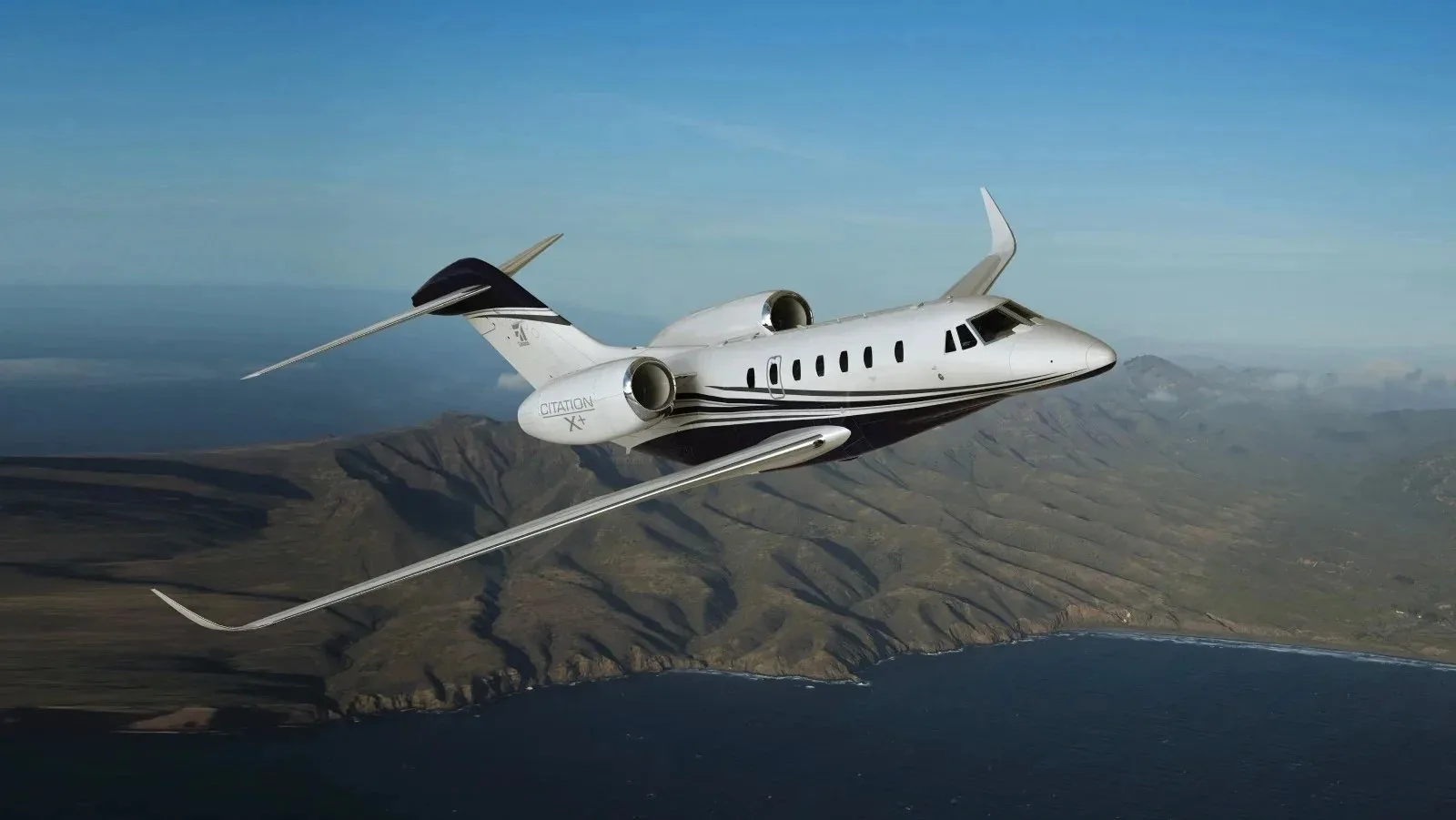
The Cessna Citation X is a super-midsize business jet and the fastest civilian aircraft ever put into series production. It cruises at Mach 0.90, carries eight passengers about 2,890 to 3,240 nautical miles depending on the source, and has a cabin 5.5 feet wide and 5.7 feet tall with roughly 82 cubic feet of baggage loaded before departure. Passenger figures on this page are cabin seats and exclude the two pilots.
One correction worth making, because the internet repeats it and we used to as well. Textron ended Citation X production in 2018 and delivered the last aircraft in 2019. Nothing has since been certified to fly faster in civil service, so the record stands. The phrase “in production” does not.
How much does a Citation X charter cost?
Bracket first, then real trips, the same way I answer on the phone.
From our quoting records a Citation X runs about $5,500 to $6,200 per hour all in: crew fees, overnights and landing fees inside the rate, with only deicing or precautionary hangar passed through at cost. Published rates sit lower on paper, around $5,100 per hour. The difference is what is inside the number, not who is cheaper.
What does a real booked Citation X trip cost end to end?
Two booked trips from our records, client details removed.
| Route | Legs | Flight time | Finished price |
|---|---|---|---|
| Jackson Hole to Cleveland (one way) | 1 | 2h 51m | $28,750 |
| Van Nuys to Sarasota (one way) | 1 | about 3h 40m | $34,000 |
Source: Peak Aviation Solutions booking records, 2026. Examples from our book, not a price list.
The Cleveland leg came in where it did because we sourced it as an empty leg, an X that had to fly back toward its base anyway. It priced at light jet money. The Sarasota trip is the airplane’s whole profile in one booking: two passengers moving between homes, coast to coast, who wanted nonstop and the cheapest honest way to have it.
Why an hourly rate never matches the invoice
Square those totals against the hourly before you compare them to anybody’s rate card, because they are not measuring the same thing.
An hourly figure buys the airplane’s time in the air. A trip total buys the whole job: getting the aircraft to Jackson Hole or Van Nuys in the first place, the operator’s daily minimum, and federal excise tax on top. A daily minimum is the least an operator will bill for a day the airplane is committed to you, even if you fly less than that. Run the hourly against the flight times above and you will come out under the invoice. That is arithmetic, not a markup.
Positioning cuts the other way too. Ask for the same routing in a week when an X is already parked near your departure and it frequently comes back for considerably less. That is exactly what happened on the Cleveland leg, and it is why flexible clients should look at what is already moving before they look at rates.
The same logic ran a rescue in March 2026. A Telluride return hit a snag, the airplane that fixed it was a Citation CJ2 already sitting on that field, so there was no repositioning inside the fix and no additional charge.
On this type the hourly is the least useful number on the page, because the X bills fewer hours than anything it competes with.
What is the Cessna Citation X, and why does it top our booking records?
People ask whether that is my doing. Mostly no. Three things drive it.
The speed changes the economics. The Cessna Citation X spends fewer hours flying, so it bills fewer hours. On a coast to coast leg that is not a bragging right, it is a discount, and for clients crossing the country it is frequently the most economical way to do it nonstop.
It fits how people actually fly. Most of my X clients travel with fewer than four people. At that count the cabin is comfortable for four hours and more, and nobody pays for seats that fly empty.
It is available. There are a lot of Citation Xs in the charter market, and availability is what turns a quote into a booking. Plenty of clients also ask for the Cessna Citation X by name, because they know the airplane and want the nonstop.
What is Mach 0.90 actually worth in hours?
Speed claims are cheap, so here is the Jackson Hole to Cleveland route priced three ways. Citation X speed is worth exactly what it removes from your day, and no more than that.
On a light jet, that route needs a fuel stop. A fuel stop is roughly 90 minutes added to your day, because the descent, the refueling, the paperwork and the climb back to altitude all take time even though the airplane barely moves.
On a midsize jet the route goes nonstop but takes about 25 minutes longer in the air than the X.
So against the light jet that client saved roughly two hours of his day. Against the midsize, under half an hour. That is the honest shape of the speed premium: transformative against anything that has to stop, incremental against anything that does not.
Which means the X earns its rate on legs long enough to threaten a fuel stop and mostly buys bragging rights on short ones. It remains the fastest private jet you can put a client on, and that still only converts to money over distance. The client on that trip normally flies light and midsize aircraft. The empty leg price plus two saved hours is what moved him up.
Citation X vs Citation X+: what actually changed
This is the question I get most from clients who have read a spec sheet, and the answer is not what they expect.
| Citation X | Citation X+ | |
|---|---|---|
| Entered service | 1996 | 2014 |
| Maximum operating speed | Mach 0.92 | Mach 0.935 |
| Cabin length | Baseline | About 14 to 15 inches longer |
| Where the stretch went | Not applicable | Galley and lavatory, not seating |
| Cabin seats, crew excluded | 8 | 8 |
| Approximate number built | About 310 | About 29 |
Search listings write it as the Citation X Plus about as often as the X+, and both names mean the same airframe. The X+ is the only civil aircraft cleared to Mach 0.935. Most published Citation X pages, including ours until now, quote that figure for the whole type. It is the X+ number. The base X is Mach 0.92, and the base X is most of the charter fleet.
The stretch is the part clients misread. About fourteen to fifteen inches went into the airframe, and it went into the galley and the lavatory rather than into seating. Nobody gets more legroom. You get a better lavatory.
Then the number that actually decides your quote: roughly 310 base X airframes were built against roughly 29 X+. Availability on the X+ is thin, and thin availability moves price more than any line on a spec sheet. If an X+ happens to be near you on your date, take it. Building a trip around finding one is not worth the wait.
Is the Citation X cabin big enough for your party?
The X wears the super-midsize label because of its speed, range and overall size. The cross section reads midsize: 5.5 feet wide, 5.7 feet tall. You notice both the moment you board, and if you are expecting the shoulder room of a true super-mid cabin, this is not that airplane.
I know because of the client in the opening. Right call for him, and I would have said so first if he had not.
That is the whole decision in one trade. Four people or fewer who care about time: the X is hard to beat. Six or more, or anyone who puts the cabin above the clock: size up. The Challenger 300 charter guide covers the airplane that trades the X’s speed for a flat floor and a wider cabin, and the what size private jet guide walks the whole ladder.
Baggage runs about 82 cubic feet, loaded before departure and not reachable in flight. Golf clubs for four, fine. Golf clubs for seven, different airplane. For that party the Hawker 800XP guide is worth reading first, because bulky gear defeats more midsize cabins than most brokers admit.
When is a Citation X the wrong aircraft?
When six or eight people are aboard for a long leg, the seats are there but the shoulder room is not, and a wider super midsize jet such as the Challenger 300 earns the difference in rate. It is the wrong pick for bulky gear, because the hold is packed before departure and stays shut once the door closes. On a leg short enough that a fuel stop was never a risk, the speed has nothing left to buy, so a light or midsize aircraft finishes cheaper. Parties crossing an ocean belong on a Gulfstream or another long-range heavy jet instead.
Peak requires interior and exterior refurbishment within the previous ten years on this type, so the year of the cabin tells you more than the year of the airframe.
Vetting an airframe that has been flying a while
Is the Citation X still in production?
No. Textron ended production in 2018 and delivered the last airframe in 2019, so nothing new is being built. The speed record survives the production line, because nothing certified since flies faster in civil service. What it means for a charter client is practical rather than historical: every tail on the market has years on it, and the refurbishment history matters more than the model year.
Production ended in 2018, so every Citation X flying charter has some years on it. We check the same things every time.
Interior and exterior refurbishment dates, both within the previous ten years. A well kept airframe with a fresh cabin is a different product than the same year wearing its original interior, and we want to deliver the first one.
Before any of that, the operator clears an Operator Vetting File: safety rating verified, an Additional Insured Certificate of Insurance on file, the D085 operations specification listing the tails authorized under their Part 135 certificate, and a W9. Company level, done once.
Then every individual flight gets a Total Flight Review inside 24 hours of departure. That review is ours, run in house rather than bought in and forwarded. A Wyvern PASS or an ARGUS TripCHEQ on the crew flying your trip is one input to it.
Around that sits weather at origin, destination and enroute, TFRs, NOTAMs, catering, ground transport and FBO call-outs. Green flies. Red never flies. Yellow is a judgment call.
Peak does not authorize single-pilot operations on any aircraft it sources. Two pilots, always. On this type that was never in question, but the policy is the policy.
You are not booking a Citation X. You are booking one specific Citation X, with a known interior, a known crew and a known refurbishment history.
Common questions about a Citation X charter
How much does a Citation X charter cost per hour?
A Citation X charter runs about $5,500 to $6,200 per hour all-inclusive at Peak Aviation Solutions, with crew fees, overnights and landing fees inside the rate (quoting records, 2026). Published rates run around $5,100 per hour. Finished trips tell more than rates: recent bookings came to $28,750 for Jackson Hole to Cleveland nonstop and $34,000 for Van Nuys to Sarasota, both one way.
How fast is the Citation X?
The Citation X is the fastest civilian aircraft ever put into series production. It cruises at Mach 0.90, about 615 mph at cruise altitude. Maximum operating speed is Mach 0.92 on the base X and Mach 0.935 on the later X+, which is the only civil aircraft cleared that fast. In practice the speed saves about 25 minutes over a midsize jet on a two and a half hour leg.
How many passengers does a Citation X seat?
The standard configuration seats eight passengers. That figure is cabin seats and excludes the two pilots. The cabin measures about 5.5 feet wide and 5.7 feet tall, which is a midsize cross section despite the super-midsize label, so the aircraft is most comfortable with four or fewer aboard on longer legs. Baggage runs roughly 82 cubic feet, loaded before departure.
What is the difference between a Citation X and a Citation X+?
The X entered service in 1996 with a maximum operating speed of Mach 0.92. The X+ arrived in 2014 at Mach 0.935 with a cabin stretch of about 14 to 15 inches, which went into the galley and lavatory rather than into seating. Both seat eight. About 310 base X airframes were built against about 29 X+, so X+ availability is thin and that drives charter price more than the specification does.
Can a Citation X fly coast to coast nonstop?
Yes. Published range runs from about 2,890 to 3,240 nautical miles depending on the source, which covers United States transcontinental routes nonstop with typical passenger loads. Range figures move with load, reserves and each source’s assumptions, so treat the spread as normal rather than as a contradiction. At Mach 0.90 the aircraft crosses the country faster than any midsize jet flying charter.
Citation X or Challenger 300: which should you charter?
Bags and bodies decide it. Four or fewer passengers who value time take the Citation X, the faster airplane. Five to eight passengers, bulky luggage, a dog, or anyone who prioritizes cabin space takes the Challenger 300, which has a flat floor and a wider, taller cabin. On price the two frequently land in the same neighborhood, so the trip rather than the budget makes the call.
The fastest airplane is sometimes the cheapest one
A client who normally flies light jets crossed half the country in two and a half hours for $28,750, because the fastest civilian aircraft ever put into series production happened to need to go his way. That is this airplane in one sentence: speed that pays for itself when the route is long, the party is small and somebody is watching the market.
Read a quote as a trip total, ask where the airplane is coming from, and ask whether it is a base X or an X+ before you accept a number built on the faster one. Ask those three things and you will learn more than any hourly rate published anywhere, this page included.
Get a Citation X charter quote priced against real finished trips
Send me a routing and I will price a Citation X charter beside a midsize on your dates, so you can see whether the speed pays for itself on your leg rather than in general.
Every option arrives with the operator already through our vetting file, the Total Flight Review scheduled, and the refurbishment history of the specific tail attached. Pay per trip. No membership, no card, no deposit sitting with us.
Request a quote or call the charter desk at (406) 296-3256. The Peak app puts the empty leg board and live quoting in your pocket.