


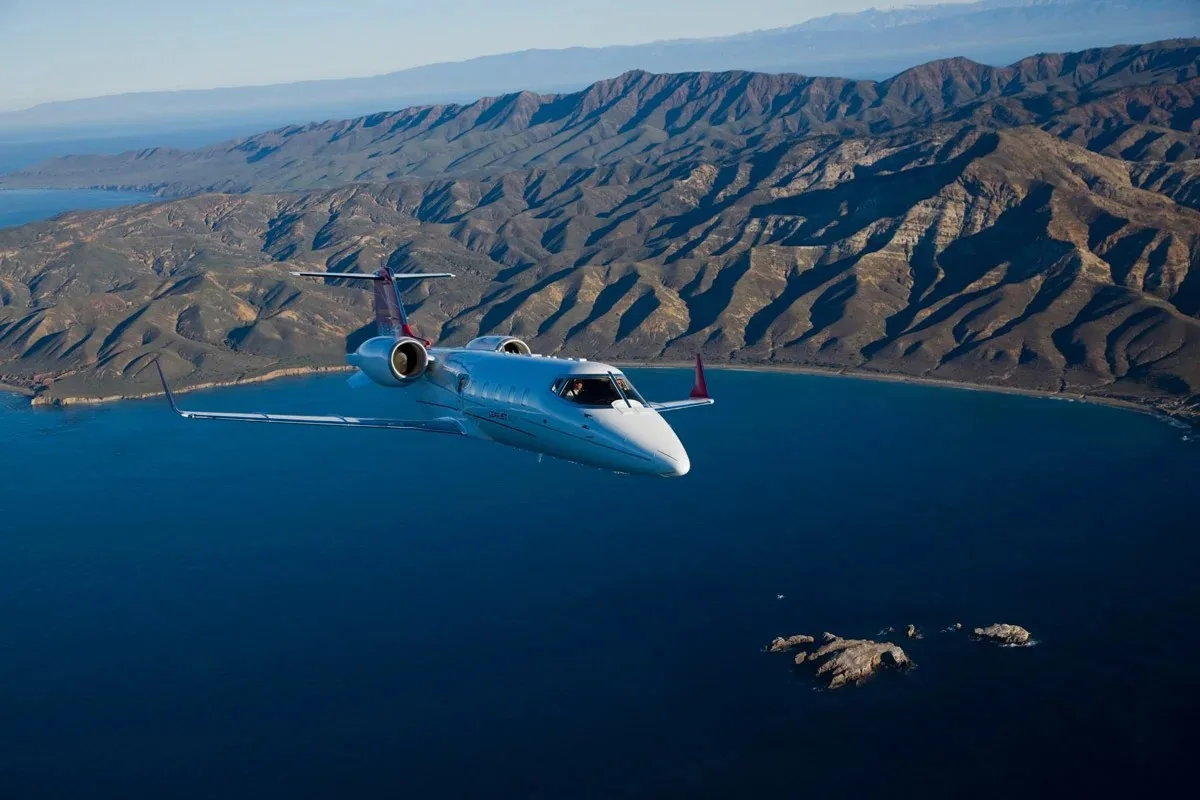
Aircraft Guides · 15 min read
Home / Aircraft Guides / Learjet 60 Charter
By Pat Sinnott, Founder of Peak Aviation Solutions. A commercial-rated pilot who has spent 21 years matching aircraft to trips, including this one, often.
Last updated: September 9, 2026
A family flies from the Bay Area to their second home near Lake Tahoe. We priced this airplane against a Citation XLS for the trip, and it could not land at Truckee with the whole family and their bags aboard.
Its version of that trip meant an alternate airport thirty minutes of flying away and about an hour of driving from their front door. We moved them to the XLS, which operates into Truckee safely with the full load, and they landed up the road from the house.
Same family, same bags, different airplane, and an hour of their arrival day handed back. That is the case against this airframe. The rest of this page is the case for it, because a Learjet 60 charter comes up on more of my midsize quotes than almost anything else.
Quick answer: A Learjet 60 charter runs about $4,100 to $5,600 per hour all-inclusive, per Peak Aviation Solutions quoting records (2026), against published rates near $4,500 (Paramount Business Jets). A recent booked trip flew Glendale, Arizona to New Braunfels, Texas, 1 hour 57 minutes, for $19,750 all in. The cabin seats seven, or eight with the belted lavatory seat.
The Learjet 60 and the later 60XR are midsize business jets seating seven passengers, or eight when the belted lavatory seat is counted, cruising around 465 knots and flying roughly 2,186 nautical miles, with a cabin about 5.9 feet wide and 5.7 feet tall at the dropped center aisle (Paramount Business Jets). Passenger figures on this page are cabin seats and exclude the two pilots.
Two corrections to what this page said before, because I would rather fix them in public. This aircraft seats seven, not eight, unless you count the belted lavatory seat. And 5.7 feet of cabin height at a dropped aisle is not a stand-up cabin, so most adults will crouch slightly. Roomier than the Learjet name suggests is a different claim, and the true one.
How much does a Learjet 60 charter cost?
Bracket first, then a real trip, the same way I quote on the phone.
From our records the type runs about $4,100 to $5,600 per hour all-inclusive: crew, overnights and landing fees inside the rate, with deicing or precautionary hangar passed through at cost when winter demands it. Published rates cluster around $4,500 per hour. The usual rule applies, which is that a number means nothing until you know what is in it.
| Route | Legs | Flight time | Finished price |
|---|---|---|---|
| Glendale, Arizona to New Braunfels, Texas (one way) | 1 | 1h 57m | $19,750 |
Source: Peak Aviation Solutions booking records, 2026. An example from our book, not a price list.
Why does a sub two hour leg cost that? Repositioning. The airplane rarely starts its day where your trip does, and short legs carry daily minimums. A daily minimum is the least an operator will bill for a day the aircraft is committed to you, whether you fly those hours or not. Compare and contrast trip totals, never hourly rates.
What does a Learjet 60 cost end to end on a real booked trip?
The table above is the honest version of that question. Glendale to New Braunfels finished at $19,750 for 1 hour 57 minutes of flying, and that figure already carries the crew, the landing fees and whatever it took to bring the airplane to the departure field. Divide it by air time and you land well above any rate card, which is exactly why we quote finished totals. Ask every broker on your list for the trip number rather than a Learjet 60 cost per hour and the quotes finally become comparable.
What the wide rate spread tells you
Search this aircraft and you will find hourly rates quoted from around $4,000 to well past $8,000, one of the widest spreads of any midsize jet, while our own quoting lives in the narrower $4,100 to $5,600 band.
The spread is mostly availability and repositioning. A 60 already near you prices at the bottom of its range. One that has to fly two states to reach you carries that cost in the quote, and closing that gap is exactly what a broker watching the market is for.
Where the Learjet 60 shines
Three things keep this airplane in our rotation.
Speed. It cruises with airplanes a class above it and climbs like it is late for something. On a typical midsize mission it gets there sooner than nearly anything at its price.
Room where it counts. The cabin runs about 5.9 feet wide, wider than most of the light and midsize class, with a dropped center aisle bringing height to 5.7 feet.
Availability. The Learjet charter market is deep on this type, and deep supply does two things for you: more options on your dates, and downward pressure on price. Both variants came off Bombardier’s Learjet line, so parts, support and pilot currency run common across the fleet you are choosing from. It is a big part of why this airplane so often lands at the affordable end of a quote set.
Can a Learjet 60 fly coast to coast nonstop?
Published Learjet 60 range is roughly 2,186 nautical miles, which is a long leg for this class and the reason the type keeps showing up on transcontinental requests.
Whether that becomes a nonstop coast to coast leg depends on the day. Passenger count, bags, fuel reserves and the winds aloft all take a bite, and westbound legs into a headwind are the ones that turn into a fuel stop. Ask for the routing to be planned against your actual load rather than an empty airplane, before anyone promises you a nonstop.
If a stop is needed it costs a landing fee and time on the ground, worth pricing against an airframe that flies the whole thing in one go.
Learjet 60 vs Learjet 60XR: what actually changed
Clients ask for the XR expecting a performance model. It is not one, and I would rather say so before you hold out for a tail that will not fly your trip any differently.
| Learjet 60 | Learjet 60XR | |
|---|---|---|
| Entered service | 1993 | 2007 |
| Airframe | The baseline | Same airframe |
| Cockpit | Original flight deck | Refreshed flight deck |
| Interior | Original design | Refreshed cabin design |
| Cruise speed | About 465 knots | About 465 knots |
| Cabin seats, crew excluded | 7, or 8 with the belted lavatory seat | 7, or 8 with the belted lavatory seat |
| Climb to FL410 | The baseline | About half a minute quicker |
The Learjet 60XR is a cockpit and interior refresh of the Learjet 60 rather than a new performance model: same airframe, same missions, same cruise speed, with time to FL410 improved by roughly half a minute. That half minute is the entire performance story, and it will not change your day.
What the XR is genuinely worth is the cabin you sit in and the flight deck the crew works from, both of which are newer. If two quotes come back at the same price and one is an XR, take the XR. If the XR costs meaningfully more, or if waiting for one delays your trip, take the 60. The hot and high limitation below is an airframe characteristic, and the XR shares it.
Can a Learjet 60 fly into hot, high mountain airports?
Here is the part the brochure pages leave out.
Engine performance at high density altitude airports is not this airplane’s strength. High elevation plus summer heat thins the air, and on hot days at mountain fields the 60 can run into weight and runway restrictions that force it to leave fuel or bags behind, or rule it out of an airport entirely.
A performance restriction is any limit an airport places on an aircraft through physics rather than rules: a runway too short, air too thin, or a day too hot for the airplane to lift its planned load safely.
What that means in practice, from our own flying. Bozeman and Jackson Hole are typically no issue, with lower field elevations and long runways. Aspen on a hot July day is where you can run into trouble, and where we start looking hard at the alternatives.
When a summer mountain trip prices this airplane close to a Citation XLS charter, we will often book the XLS even at a slightly higher number, because avoiding a performance restriction is worth more than the difference. That is not a knock on the airframe. It is the shape of it.
If your flying stays at lower elevations, none of this applies and the 60 is simply a fast, comfortable, well priced midsize.
Learjet 60 or Citation XLS: how we actually decide
These are the two midsize jets my clients fly most, so this comparison comes off real trips rather than spec sheets.
| Learjet 60 | Citation XLS | |
|---|---|---|
| Cruise speed | Faster, about 465 knots | Slower, about 431 knots |
| Published range | About 2,186 nm | About 1,722 nm |
| Short runways | The weak spot | The strength |
| Hot and high | Restrictions possible | Rarely restricted |
| Baggage | Adequate | Larger |
| Charter availability | Deep | Thinner |
Sources: Paramount Business Jets published specifications; Peak Aviation Solutions booking records, 2026.
The decision comes down to four questions. How short is the runway, how high and hot is the airport, how much luggage is coming, and how far is the leg. Long leg, normal airport, normal bags: the 60 is faster and usually cheaper. Short field, mountain strip, heavy bags: the XLS earns its keep.
If the party is four or fewer and the leg is shorter, the Phenom 300 guide covers the light jet answer at a lower rate. For a group that wants a shorter runway and a lighter airplane still, the Citation CJ3 guide is the rung below that. The what size private jet guide walks the full ladder if you want to see where the midsize class sits.
Learjet 60 versus Hawker 800XP: which should you book?
The 800XP is the other airframe that turns up on a midsize jet charter quote beside this one.
Seating settles most of it. The Hawker carries eight without borrowing the lavatory seat, so if the eighth passenger is a real person rather than a spare chair, that is your airplane. The 60 answers back with cruise speed and a longer published leg.
Book the Hawker when the group is large and nobody is counting minutes. Book the 60 when the leg is long, the field is ordinary and speed is what you are paying for. The Hawker 800XP guide walks the rest of that trade.
What I check before booking a Learjet 60
Same list every time, whatever the airplane.
Before any client of ours boards an operator’s aircraft, that operator clears an Operator Vetting File: safety rating verified, an Additional Insured Certificate of Insurance on file, the D085 operations specification listing the tails authorized under their Part 135 certificate, and a W9. Company level, done once.
Every individual flight then gets a Total Flight Review inside 24 hours of departure. That review is ours, run in house rather than purchased. A Wyvern PASS or an ARGUS TripCHEQ on the operator, the tail and both pilots flying your trip is one input to it, returning green, yellow or red.
Green flies. Red never flies. Yellow is a judgment call.
Around that sits weather at origin, destination and enroute, TFRs, NOTAMs, catering, ground transportation and FBO call-outs. Peak does not authorize single-pilot operations on any aircraft it sources. Two pilots, always.
On this type we add two checks: which variant and what year, and whether the routing touches a field where density altitude gets a vote.
When is a Learjet 60 the wrong aircraft?
Three trips send us somewhere else, and I would rather name them here than discover them at the ramp.
A summer afternoon into a short mountain field is the first. Density altitude gets a vote there, and an airframe with more runway margin is the safer book even when it prices higher.
The second is a trip where that eighth seat is a real passenger. Counting the belted lavatory seat as a seat is optimistic on anything longer than a short hop, and eight travelling adults belong in something with eight proper chairs.
The third is a short leg out of a small field. Under roughly two flight hours per leg a turboprop usually wins on cost, and two to three hours per leg is very light jet country, with everything over three hours settled by passenger count and distance rather than the clock. Those bands overlap rather than switching cleanly, so price across the boundary instead of guessing at it.
Common questions about a Learjet 60 charter
How much does a Learjet 60 charter cost per hour?
About $4,100 to $5,600 per hour all-inclusive at Peak Aviation Solutions, with crew, overnight and landing fees inside the rate (quoting records, 2026). Published rates sit around $4,500 per hour (Paramount Business Jets, 2026). A recent booked trip ran $19,750 for Glendale, Arizona to New Braunfels, Texas, 1 hour 57 minutes in the air. Repositioning and daily minimums move finished totals more than the hourly rate does.
How many passengers does a Learjet 60 seat?
Seven passengers, or eight when the belted lavatory seat is counted. Those are cabin seats and exclude the two pilots. The cabin measures about 5.9 feet wide and 5.7 feet tall at the dropped center aisle, so most adults crouch slightly rather than stand upright, though it is wider than the Learjet name leads people to expect. For six or fewer on a mid-length leg it is comfortable.
What is the difference between a Learjet 60 and a Learjet 60XR?
The 60XR arrived in 2007 as a cockpit and interior refresh of the 1993 Learjet 60. It is the same airframe flying the same missions at the same cruise speed, with time to FL410 improved by about half a minute. Seating is identical. The XR is worth choosing for the newer cabin and flight deck when availability and price are equal, and it is not worth waiting for otherwise.
How fast is the Learjet 60?
It cruises around 465 knots, which puts it among the fastest midsize jets in charter service and within reach of some super-midsize aircraft (Paramount Business Jets). It also climbs to altitude quickly, which shortens trips and gets above weather sooner. Speed is the airplane’s clearest advantage over the Citation XLS, its most common rival on a midsize quote, which cruises around 431 knots.
What is the Learjet 60’s biggest weakness?
Engine performance at hot, high elevation airports. High density altitude thins the air and can force weight or runway restrictions that comparable midsize jets avoid, occasionally ruling the aircraft out of short mountain fields entirely (Peak Aviation Solutions operating experience). Bozeman and Jackson Hole are typically no problem. Aspen on a hot July day is where the limitation shows. At lower elevations it rarely appears at all.
Learjet 60 or Citation XLS: which should you charter?
Four factors decide it: runway length, field elevation and temperature, baggage volume, and leg length. The Learjet 60 is faster and flies further, and deep availability often prices it lower. The Citation XLS handles short, hot and high airports the 60 cannot with a full load, and carries more baggage. On summer mountain trips Peak Aviation Solutions often books the XLS even at a slightly higher price.
A fast airplane, priced fairly, with one question to ask
This aircraft delivers more speed per dollar than almost anything in the midsize class, and the market is deep enough that a well sourced quote usually lands kindly. Seven seats rather than eight, a cabin you crouch in slightly, and a real limitation on hot mountain afternoons are the price of that.
The one thing that decides whether it is your airplane: where does the trip actually land, and in what season? Answer that honestly and the rest mostly makes itself.
Get a Learjet 60 charter quote sourced rather than listed
Send the trip and I will check which 60s are actually near your routing, verify the airframe and crew through the Total Flight Review, run the density altitude math if mountains are involved, and price an XLS beside it.
Pay per trip. No membership, no card, no deposit sitting with us. Request a quote or call the charter desk at (406) 296-3256. Live empty legs and quotes on your phone are on the Peak app.