


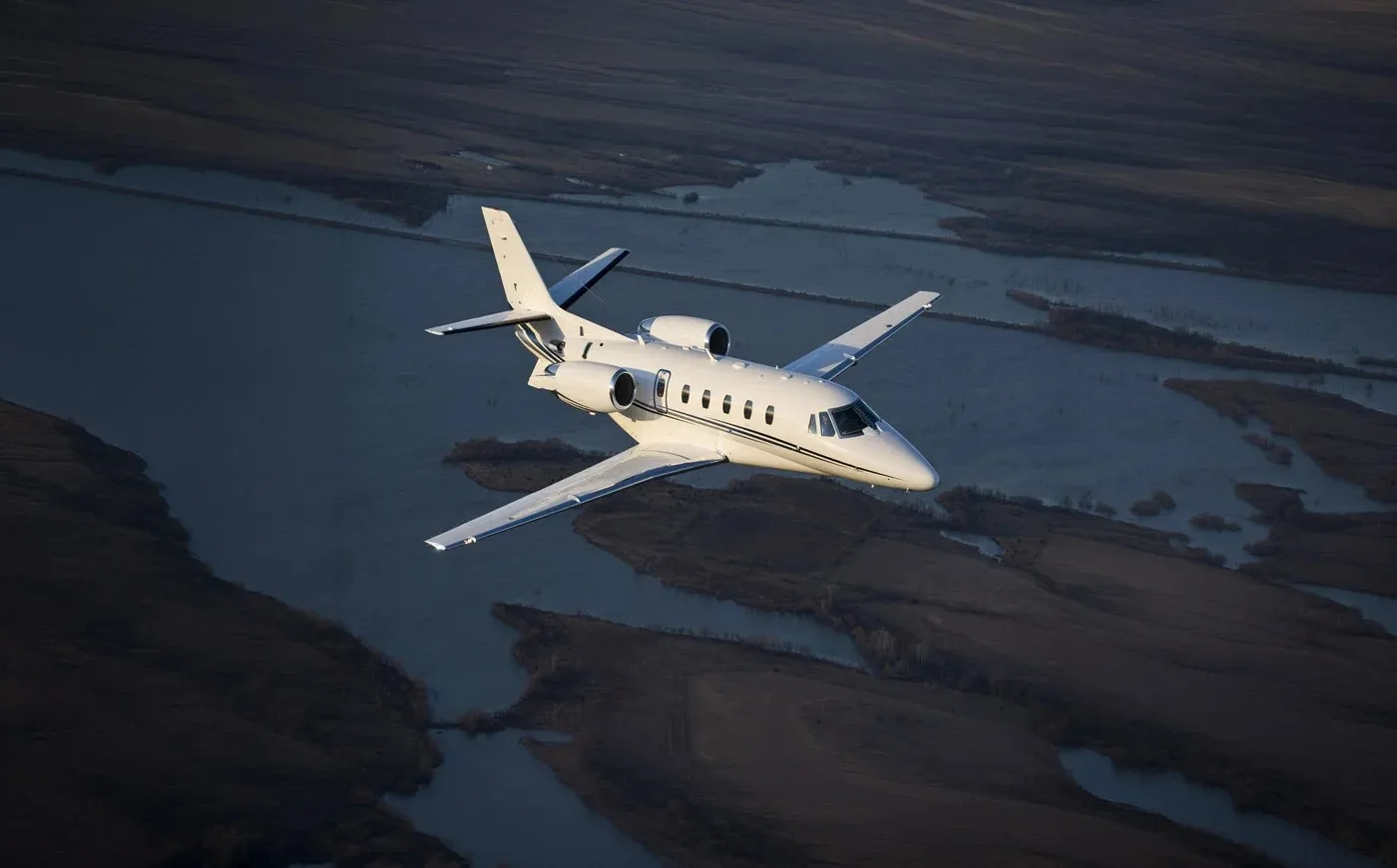
Aircraft Guides · 15 min read
Home / Aircraft Guides / Citation XLS Charter
By Pat Sinnott, Founder of Peak Aviation Solutions. Pilot first, broker second, and a repeat customer of this airplane on behalf of his clients for years.
Last updated: September 9, 2026
Start with the thing most brokers let clients believe. There are three airplanes in this family, three different names, and the cabin is exactly the same in all three. Same 18.5 feet of length, same 422 cubic feet, same 5.5 by 5.7 foot cross section.
Nobody should pay a premium for a badge that buys no extra room. The newer badges buy a newer flight deck, a younger airframe and a shorter runway requirement, which matters, just not in the way the names suggest.
If a Citation XLS charter is judged on glamour it loses to half the midsize class. It gets booked constantly anyway, because it does two things clients need more often than they expect: it gets into short airports, and it swallows luggage.
Quick answer: A Citation XLS charter prices in the mid $4,000s per hour published, about $4,300 at Paramount Business Jets (2026), with real trips quoted all in. A recent Peak Aviation Solutions booking flew Omaha to Cleveland Burke Lakefront, 1 hour 51 minutes, for $11,850 all in. The cabin seats seven to nine and carries roughly 80 cubic feet of baggage.
The Cessna Citation Excel, XLS and XLS+ are midsize jets sharing one identical cabin, 18.5 feet long and 422 cubic feet, 5.5 feet wide and 5.7 feet tall, seating seven to nine passengers depending on layout, with published range varying from about 1,540 to 2,100 nautical miles by source and condition. Passenger figures on this page are cabin seats and exclude the two pilots.
Citation Excel vs Citation XLS vs XLS+: which one will you actually fly?
The names confuse everyone, so here is the practical version in a table before the prose.
| Citation Excel | Citation XLS | Citation XLS+ | |
|---|---|---|---|
| Entered service | 1998 | 2004 | 2008 |
| Cabin length | 18.5 ft | 18.5 ft | 18.5 ft |
| Cabin volume | 422 cu ft | 422 cu ft | 422 cu ft |
| Cabin seats, crew excluded | 7 to 9 | 7 to 9 | 7 to 9 |
| Takeoff distance, published | about 3,959 ft | between the two | about 3,560 ft |
| What actually changed | The baseline | Updated flight deck and systems | Newer flight deck, shortest field performance of the three |
The cabin line is the important one, and it repeats on purpose. The Citation Excel, XLS and XLS+ share one cabin cross section and one cabin length, so no variant in this family gives a passenger more room than another. What separates them is age, flight deck and how much runway they need.
That takeoff figure is the real difference. About 3,560 feet for the XLS+ against about 3,959 for the Excel. Four hundred feet sounds like nothing until your trip lands somewhere with 4,000 feet of pavement in July.
Published range for the family runs from about 1,540 to 2,100 nautical miles depending on source and condition, which is why I ask for the load and the reserves before quoting a leg near the top of that band.
What shows up when we source this aircraft: mostly XLS. The Citation Excel name dates to the late 1990s, but the airframes actually flying charter today are overwhelmingly early 2000s through 2010s builds. We simply do not see 1990s examples come through our quotes.
One more naming trap. Cessna built all three, and Cessna has sat inside Textron Aviation since 2014, so a quote that says Cessna Citation XLS and one that says Textron Aviation are describing the same jet. Listings write the newest of the three as XLS+ or Citation XLS Plus more or less interchangeably.
So when a proposal says Excel family, ask which variant and what year, and expect the answer to be an XLS from this century. Ours says so up front.
How much does a Citation XLS charter cost?
Published rates sit in the mid $4,000s per hour, about $4,300 at Paramount Business Jets. As always, a published hourly rate and what a trip really costs are different animals, so here is a booked one.
| Route | Legs | Flight time | Finished price |
|---|---|---|---|
| Omaha to Cleveland Burke Lakefront (one way) | 1 | 1h 51m | $11,850 |
Source: Peak Aviation Solutions booking records, 2026. An example from our book, not a price list.
The airplane made that price, not us. It was based at Burke and needed to end its day there, which is why the number came in where it did. We offered Hopkins too, since it sits closer to the client’s house, but moving the arrival would have added real cost, so the clients took Burke and kept the difference.
That small reposition penalty is why a ten minute hop is never as cheap as it looks on a map. Operators price cycles as much as hours.
What does a Citation XLS cost end to end on a real booked trip?
Omaha to Cleveland Burke Lakefront came to $11,850 for 1 hour 51 minutes of flying, and that total is the whole thing rather than an air time slice. It carries the crew, the fees, the tax and whatever it took to have the airplane sitting in Omaha that morning. A Citation XLS cost quoted per hour tells you almost nothing about which of two proposals is cheaper on your dates. Ask for the finished number on your exact routing and compare those.
What an hourly rate leaves out
About $4,300 an hour is what this type bills for time in the air. The $11,850 is what the whole trip cost: the flying, whatever it took to bring the aircraft into position, the operator’s daily minimum and federal excise tax. A daily minimum is the floor of hours an operator bills for holding the airplane for your day, even when you fly fewer. Multiply the published hourly by 1 hour 51 minutes and you get a smaller number than the invoice. That gap is the trip, not a markup.
An airplane already where you are costs nothing to bring to you, and that principle is also our safety net. A return out of Telluride in March 2026 ran into a problem with the aircraft we had sourced. A Citation CJ2 was already sitting on that field, so we put the client on it to Fort Worth at no additional charge.
For your own routing the honest answer is a quote rather than a rate card.
What does short field performance mean for a Citation XLS?
Short field performance is an aircraft’s ability to take off and land safely on runways other jets in its class cannot use, and it is decided by wing and engine design rather than pilot bravado.
Every aircraft page claims versatility. Here is what it concretely means for this one.
Truckee, the airport serving Lake Tahoe, is short enough and high enough that a Learjet 60 carrying a real passenger and baggage load frequently cannot use it and has to divert to an alternate, adding drive time to everyone’s arrival. The XLS typically flies straight in with no performance restrictions at all.
That one fact reshapes trips. It means landing at the small airport fifteen minutes from the house instead of the big one an hour away, a hot July departure from a mountain strip without offloading bags, and Burke Lakefront instead of the far side of Cleveland.
If your flying touches ski towns, lake towns or any airport described as convenient but small, this trait matters more than cruise speed ever will.
Why does the XLS sometimes cost more than faster jets?
Counterintuitive but true, and our own records show it. On real quotes this airplane often comes back above a Learjet 60 charter, even though the 60 is faster, longer legged and carries the higher published rate of the two.
The reason is market supply. Learjet 60s are plentiful in the charter fleet, and deep supply pushes prices down. XLS availability is thinner relative to demand, precisely because the airplane is so useful, and geography compounds it trip by trip. Supply and timing move charter prices more than an airplane’s own operating costs do.
When the two price close together the decision reverts to the trip. Short or high field, take the XLS. Long fast leg from a normal airport, the 60 earns it.
What is the Citation Excel interior actually like?
Two names, one cabin, and the same answer for all three variants. It is 5.5 feet wide and 5.7 feet tall.
Do clients complain? Almost never, and the reason is process rather than luck. Before anything is booked we ask whether a client has an aircraft preference, because prior experience is the best predictor of satisfaction. For anyone new to the type, every proposal we send spells out the cabin dimensions of every option on it, so nobody boards expecting more room than is there.
What the airplane gives back: a bright, quiet cabin with large oval windows, seats that stay comfortable for a two hour leg, a proper aft lavatory, and roughly 80 cubic feet of baggage, more than most of its class. That is why ski trips, golf groups and family hauls keep choosing it. The Hawker 800XP guide covers the midsize alternative that gives up exactly that advantage.
Does the Citation XLS have a stand up cabin?
No. At 5.7 feet of cabin height the Citation XLS does not have a stand up cabin, and neither does the Excel or the XLS+, since all three share one cross section. Most adults walk the aisle with a slight crouch and sit perfectly comfortably once they are down. If standing upright in the cabin is a hard requirement for someone in your party, the search moves up to a super-midsize or heavy airframe and the price moves with it.
Ask which year the interior was refurbished
Since all three variants share one cross section, what separates two proposals at the same hourly rate is rarely the shape of the cabin. It is the age of what you are sitting in. Every quote we send carries the aircraft’s year and refurbishment history. Ask for both, on our proposals and on anyone else’s.
Citation XLS versus Phenom 300: which should you book?
This is the fork that comes up most often on a light jet charter quote, because the two overlap on price more than their class labels suggest.
Seats and bags settle it. The Phenom 300 commonly seats six, seven with a belted lavatory seat and eight with a divan, and its hold is smaller. The XLS seats seven to nine and takes roughly 80 cubic feet of luggage, which is why ski parties and golf groups keep landing here.
Book the Phenom when four to six people travel light on a shorter leg, since it usually prices below this airplane. Book the XLS when bags are the constraint. The Phenom 300 guide covers that airframe in full, and the Citation CJ3 guide covers the rung below it.
When is a Citation XLS the wrong aircraft?
Three cases, and we name them before the quote goes out rather than after.
A long transcontinental leg is the first. Published range for the family spans a wide band, and a full cabin with honest reserves usually puts a fuel stop in the plan, so a faster and longer legged midsize earns its premium there.
Cabin height is the second. Anyone who needs to stand fully upright will be unhappy here, whatever badge is on the tail.
Short hops are the third. Under about two flight hours per leg a turboprop is normally the cheaper answer, and the two to three hour band per leg belongs to very light jets, with anything beyond three hours decided by headcount and distance rather than by the clock. Those bands overlap instead of switching over cleanly, so price on both sides of the line before you commit.
What Peak checks before booking this type
Every airframe we propose carries its vetting with it, and that vetting is two separate pieces of work.
The operator earns an Operator Vetting File with us first, once, before any of its aircraft goes in front of a client. Safety rating verified, an Additional Insured Certificate of Insurance on file, the D085 operations specification listing the tails authorized under that operator’s Part 135 certificate, and a W9.
Then comes the Total Flight Review, which we run ourselves within 24 hours of every flight. It is our in-house check rather than a report we buy, though one input to it is a Wyvern PASS or an ARGUS TripCHEQ on the crew flying your trip. Around that sits weather, TFRs, NOTAMs, catering, ground transportation and FBO call-outs.
Green flies. Red never flies. Yellow is a judgment call.
Peak does not authorize single-pilot operations on any aircraft it sources. Two pilots, always.
Common questions about a Citation XLS charter
How much does a Citation XLS charter cost per hour?
Published rates for this type run in the mid $4,000s per hour, about $4,300 at Paramount Business Jets (2026). Real trips are quoted all in rather than by rate card. A recent Peak Aviation Solutions booking flew Omaha to Cleveland Burke Lakefront, 1 hour 51 minutes, for $11,850 all in. Repositioning, cycles and daily minimums move the finished number more than the hourly rate does.
What is the difference between the Citation Excel, XLS and XLS+?
Same family, three generations: Excel from 1998, XLS from 2004, XLS+ from 2008. The cabin is identical across all three at 18.5 feet long and 422 cubic feet, so no variant offers more room. What changes is airframe age, flight deck and runway requirement. Published takeoff distance runs about 3,959 feet for the Excel against about 3,560 feet for the XLS+.
How many passengers does a Citation XLS seat?
Seven to nine passengers depending on the interior layout, typically arranged as a club four with additional seats fore and aft. Those are cabin seats and exclude the two pilots. Baggage capacity runs roughly 80 cubic feet, more than most of the midsize class. Peak Aviation Solutions most often books the type for four to six passengers traveling with full luggage.
What is the Citation Excel interior like inside?
The Excel, XLS and XLS+ share one cross section, 5.5 feet wide and 5.7 feet tall, so most adults stand with a slight crouch rather than fully upright. The cabin is 18.5 feet long and 422 cubic feet, bright and quiet, with large oval windows, a proper aft lavatory and roughly 80 cubic feet of baggage. What varies between airframes is age and refurbishment rather than shape.
What is the range of a Citation XLS?
Published range varies from about 1,540 to 2,100 nautical miles depending on the source and the condition quoted, since range figures move with passenger load, reserves and assumed cruise setting. In practice the type covers most domestic legs of three to four hours nonstop with a moderate load. Longer transcontinental routes generally require a fuel stop, which adds a landing fee and ground time.
Citation XLS or Learjet 60: which is better?
Neither, until the trip is known. The Learjet 60 is faster and flies further, and deeper market supply often prices it lower. The XLS gets into short, hot and high airports the 60 cannot manage with a full load, and carries more baggage. For mountain and lake destinations Peak Aviation Solutions usually recommends the XLS, and for long legs between major airports, the 60.
The airplane that lands where you actually want to go
Nobody books this aircraft to admire it at the big airport an hour from the house. Its whole argument is landing at the small one up the road, with everyone’s bags aboard, in the season you actually travel. That is why this unglamorous airplane keeps out-booking prettier ones.
Where it sits on the ladder above and below is covered in the what size private jet guide.
Get a Citation XLS charter quote with the airport math done
Tell me where you are actually going rather than the nearest big city. I will source the options near your routing, run the tail and crew through the Total Flight Review, check the runway and density altitude numbers for your dates, and price a Learjet 60 alongside.
Pay per trip. No membership, no card, no deposit sitting with us.
Ask for a Citation XLS charter quote with the small airport named up front. Request a quote or call the charter desk at (406) 296-3256. Live empty legs and quotes are on the Peak app.