


Aircraft Guides · 17 min read
Home / Aircraft Guides / King Air Charter
By Pat Sinnott, Founder of Peak Aviation Solutions. Commercial-rated pilot, 21 years in the industry, and a believer that the right airplane is sometimes the one with propellers.
Last updated: September 9, 2026
A King Air charter is the recommendation clients least expect from me, and the one I make with the most confidence. On a short regional leg the jet most people assume they want is often the more expensive way to arrive slightly later than they needed to.
What follows is that arithmetic, worked out on trips we actually flew and invoiced. It also corrects two things this page used to say. The old version leaned on a hard two-hour rule, and the honest version of that rule has three bands that overlap. It also quoted a nine-seat cabin, which is a commuter figure rather than a charter one.
Seat counts on this page are passengers in the cabin. The two pilots are not included in any of them.
Quick answer: A King Air charter suits legs under about two flight hours, where the turboprop’s lower rate beats a jet’s speed. Published King Air 200 rates run near $2,000 per hour (Paramount Business Jets, 2026), and booked Peak round trips have finished between $11,500 and $17,500. Cabin seats run five in a C90, six to seven in a 200 or B200, and seven to eight in a 350.
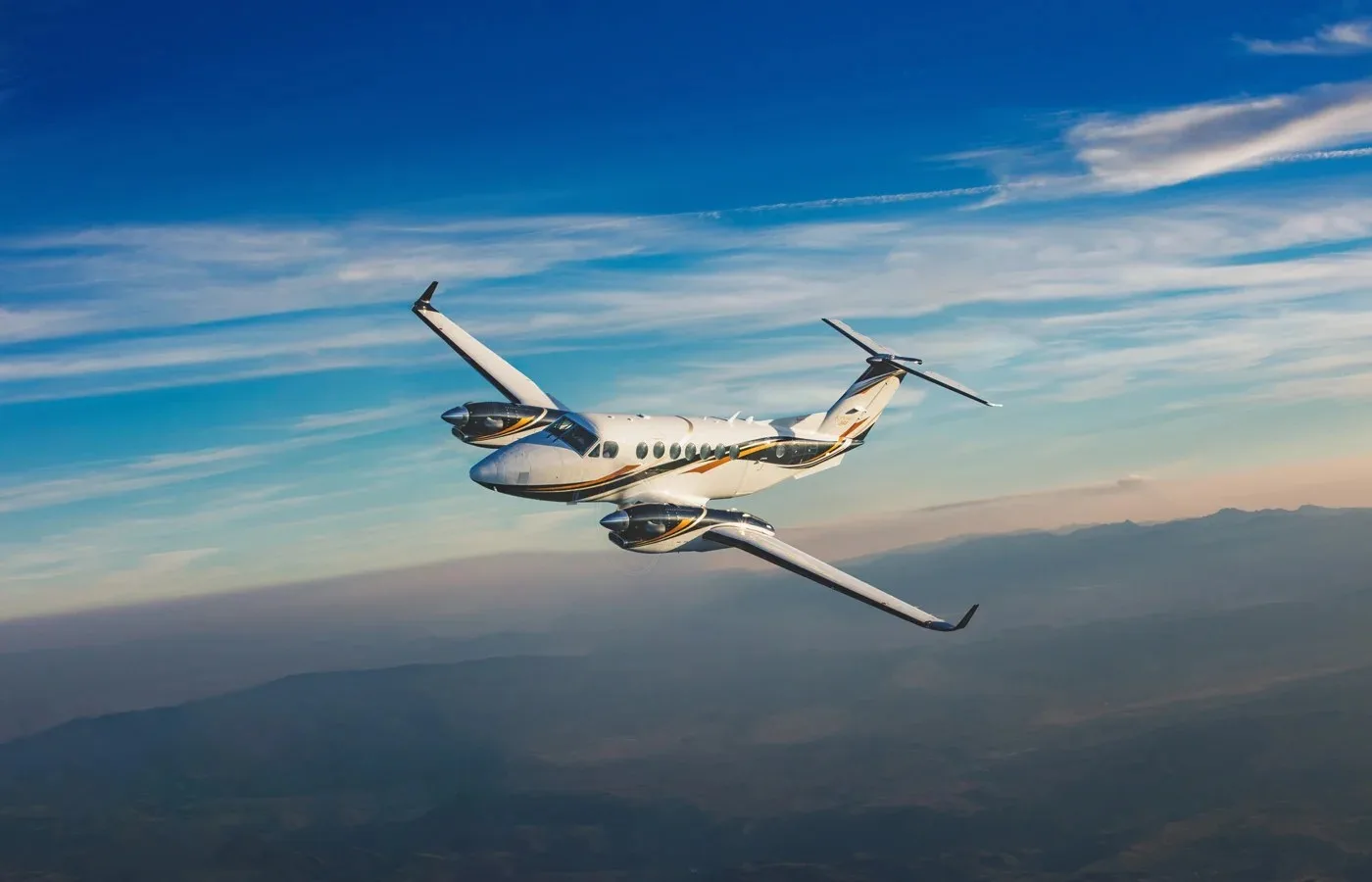
The Beechcraft King Air is a family of twin-engine turboprops sold in three distinct sizes: the C90, the 200 and B200, and the 350, with cabins of 218, 303 and 344 cubic feet. Those are three different aircraft rather than three trim levels of one, and the seat count moves with them.
How much does a King Air charter cost?
What a real booked King Air trip cost, end to end
Two Bozeman to Kalispell round trips sit in our records, a year apart, on two different airplanes. In May 2024 a King Air 200 flew it as two legs totalling 1 hour 59 minutes of flying, so about an hour each way, and came to $11,500 all in. In May 2025 the smaller C90A flew the same city pair as two legs totalling 2 hours 37 minutes, so a little under an hour and twenty minutes each way, and came to $14,150.
The smaller cabin cost more. That looks backwards, so here is the explanation I give on the phone.
Part of the gap is that these are different years and different routings, and neither of those holds still. The rest is availability and lead time, which move a turboprop price further than the choice between two models does. When you ask shifts the number more than which King Air you ask for.
Behind the 2024 booking was a local development group building a hotel up in Kalispell. They left after breakfast, walked the site, met their people on the ground, and were home for dinner. By road the same day is at least ten hours of driving.
Published rates for the King Air 200 sit around $2,000 per hour (Paramount Business Jets, 2026), roughly half a light jet’s hourly rate. Set that beside the trip totals above and the arithmetic looks wrong. It is not.
An hourly rate buys the airplane’s time in the air and nothing else. A daily minimum is the smallest number of hours an operator will bill for any day it holds an aircraft and crew for you, whether you fly them or not. A trip price carries that minimum, the repositioning flight that brings the airplane to you, and federal excise tax. Multiply a rate by your flight time and you will land under the real invoice every time.
Catch a day when a King Air is already parked where your trip begins and the same two legs frequently price out for considerably less. That is why I tell flexible clients to look at what is already moving, and it is the whole idea behind empty leg flights.
There is a version of this that works in your favour when a trip goes sideways. In March 2026 a return out of Telluride hit a problem, and the answer was a Citation CJ2 sitting on that same ramp. The client flew home to Fort Worth on it at no additional charge, which was only possible because there was no repositioning to pay for.
The three bands that replaced the two-hour rule
This page used to state a single crossover at two hours. That was too clean, and I have retired it.
The crossover sits in three overlapping bands: under about two flight hours per leg a turboprop usually wins, two to three hours favours a very light jet, and beyond three hours the answer is a light, midsize, super-midsize, heavy or ultra-long-range jet chosen by passenger count and distance rather than by the clock. The bands overlap on purpose. Around the two and three hour marks either class is defensible, and passengers and luggage decide more often than time does.
The bottom band did not change. Under about two hours, the turboprop math usually wins. A turboprop bills fewer dollars per hour and flies more of them, a jet bills more per hour and flies fewer, and on a short leg the time difference is minutes while the rate difference is real money.
The part that changed is what sits above it. There is no single moment where a King Air stops making sense and one jet takes over. There is a band where a very light jet gets cheaper and quicker, and then a much wider band where the question stops being turboprop against jet and becomes which jet. Four people to Denver and ten people to a coast are both past three hours, and they are not the same airplane.
Flight time in all of this is per leg, not per trip. That matters more than it sounds. A Jackson Hole to Missoula booking in our records from July 2026 shows 3 hours 6 minutes of flying at $17,500 on a C90A, which reads like a three-hour trip and looks like it breaks the rule.
It is two legs totalling 3 hours 6 minutes, so about an hour and a half each way. Sorted the way anyone actually plans a trip, it sits squarely in the turboprop band. The turboprop vs light jet comparison works the same sorting through our whole book.
King Air B200 charter: the six to seven seat middle
The 200 and B200 are the airplanes most people mean when they say King Air, and they are the ones our own booking history sits on.
The cabin runs 16.7 feet long and 303 cubic feet, seating six to seven passengers, about 4.5 feet wide and 4.8 feet tall (Paramount Business Jets). That is seated height rather than stand-up. In our own loading it swallows more baggage than those dimensions suggest, which is why duffels, dogs and ski bags rarely become a conversation.
Published range is about 1,075 nautical miles with IFR reserves at roughly 290 knots (Paramount Business Jets), which covers Bozeman to Kalispell, Jackson, Denver, Salt Lake or Seattle without drama.
King Air C90 charter: five seats and the shortest legs
The C90 family is the small end. Cabin 12.4 feet long, 218 cubic feet, five passenger seats.
A King Air C90 charter books for the same short mountain legs as the 200, with a smaller cabin and a shorter day’s reach. Our two C90A trips are the Kalispell round trip at $14,150 and the Jackson Hole to Missoula round trip at $17,500, both described above. Those two numbers are what a smaller cabin on those missions has actually cost through us, not a rate card.
Five seats is the honest figure. If you have six people and real luggage, the C90 is the wrong end of the family and I will say so before you book.
King Air 350 charter: seven to eight seats and the longest reach
The 350 is the largest of the three, with a 19.5 foot cabin, 344 cubic feet and seven to eight passenger seats. Published range is about 1,806 nautical miles.
A King Air 350 charter is the one to ask for when the party is seven or eight, when the trip stretches toward the top of the turboprop band, or when a high field on a warm afternoon is going to take a bite out of what a smaller airplane can carry. It costs more per hour than a 200. It also does not require a second airplane when the group grows.
Our own first-hand booking history is on the 200, the C90 and the PC-12, so the 350 section here rests on published specification rather than on our invoices. When a client’s mission calls for one we source it the same way, through the same vetting.
What is the difference between a King Air C90, 200 and 350?
| Model | Cabin length | Cabin volume | Passenger seats | Published range |
|---|---|---|---|---|
| King Air C90 family | 12.4 ft | 218 cu ft | 5 | Regional legs, shortest of the three |
| King Air 200 / B200 | 16.7 ft | 303 cu ft | 6 to 7 | About 1,075 nm with IFR reserves (Paramount Business Jets) |
| King Air 350 | 19.5 ft | 344 cu ft | 7 to 8 | About 1,806 nm |
Seats are cabin seats and exclude the two pilots.
How many people can a King Air actually carry that far?
This is the number nobody prints next to the range figure, and it decides more trips than any other line on this page.
Published range assumes a light airplane. Fill the seats and it collapses. A King Air 250 quoted at 1,575 nautical miles carries seven people about 636 nautical miles. Same airplane, same tanks, less than half the reach, because fuel and passengers compete for the same weight.
So when you read 1,075 or 1,806 nautical miles anywhere on this page, read it as the airplane on its best day rather than as your trip. Give your broker the real head count and the real bag count before anyone quotes you a range.
Heat and elevation push the same direction. Summer afternoons out of high fields cut what any aircraft can lift, so a July departure from a mountain airport with a full party deserves the question in advance rather than a surprise at the ramp.
Can a King Air land on short or unpaved runways?
The bands are about money. This part is about access, and it is why we sometimes book a King Air even when the money is close.
Turboprops take off and land in far less runway than a light jet needs. That opens small-town airports, high-country fields and short runways that sit fifteen minutes from where you are actually going, places a jet either cannot use at all or can only use with painful weight limits.
Unpaved is the part that gets oversold. The airplane is capable of unpaved surfaces and we still do not book them, because unpaved operations sit outside the safety parameters we apply to everything we source. Short paved fields with an FBO and ground handling are where these trips go, so name the airport in your request and the runway answer comes back with the quote.
King Air versus Pilatus PC-12: which should you book?
Quote both and let the trip decide. The Pilatus PC-12 charter guide covers the single-engine alternative in full: one cabin, a large aft cargo door, seven to eight seats. The 200 and B200 answer with a second engine, deeper charter availability in this region, and six to seven seats. On a short mountain leg with real bags either one is defensible, and the what size private jet guide puts the whole ladder in one place.
The propeller safety conversation, honestly
A good part of my job on turboprop quotes is education, because plenty of clients quietly believe propellers mean a step down in safety.
Our standard does not change with aircraft type. Every Peak turboprop trip flies with two pilots, always, even on aircraft certified for single-pilot operation.
The paperwork is the same as it is on a heavy jet, in two parts. Every operator clears an Operator Vetting File before it appears on one of my quotes: safety rating verified, an Additional Insured Certificate of Insurance on file, the D085 operations specification listing the tails authorized under their Part 135 certificate, and a W9. That is a company-level check, done once, before any client boards that operator’s aircraft.
Every departure then carries its own Total Flight Review, completed inside 24 hours of the flight. That is our own in-house review, not a report we buy. A Wyvern PASS or an ARGUS TripCHEQ on the assigned crew is one input to it.
The rest is weather at origin, destination and enroute, Temporary Flight Restrictions, NOTAMs, catering, ground transport and an FBO call-out when the hour calls for it. Green flies. Red never flies. Yellow gets a decision rather than a rubber stamp, and that decision has changed crews before.
Clients who fly one discover the turboprop was never the compromise they braced for, just a different tool with a different sweet spot held to the same standard.
King Air or jet: the four things I ask in order
Four of them, and they settle it faster than any table.
How long is the leg, per leg rather than per trip? Under about two hours the turboprop math usually wins, and between two and three a very light jet starts earning its rate.
How many people and how much gear? Five caps the C90, six to seven the 200 and B200, seven to eight the 350. Cabin size rules out whole classes before the clock does.
How short is the runway, and how warm is the afternoon? If the field is tight or high, the decision may already be made.
Do your dates bend? Turboprop availability in mountain regions is genuinely good, which matters most exactly when your dates cannot move.
When a King Air is the wrong aircraft
Three cases, and you will hear them from me before you book.
A party of nine, because no King Air in charter service has the cabin for it. A leg past about three hours, where a jet buys back enough of the day to be worth its rate. And a schedule that cannot move at all, where the honest answer is whichever vetted aircraft is genuinely free on your date. The Phenom 300 guide picks up the first two.
Common questions about a King Air charter
How much does a King Air charter cost per hour?
Published rates for the King Air 200 run around $2,000 per hour (Paramount Business Jets, 2026), roughly half a light jet’s hourly rate. Peak Aviation Solutions quotes all-in trip prices instead. A booked Bozeman to Kalispell round trip in May 2024 flew two legs totalling 1 hour 59 minutes and came to $11,500 with crew and fees included. Repositioning, the operator’s daily minimum and federal excise tax all sit inside a trip price and none of them sit inside an hourly rate.
How many passengers does a King Air seat?
It depends which King Air. The C90 family seats five, the 200 and B200 seat six to seven, and the 350 seats seven to eight. Those are cabin seats and exclude the two pilots, who fly every Peak trip regardless of what the aircraft is certified for. Higher figures published elsewhere generally describe commuter layouts rather than charter cabins. The 200 cabin runs about 4.5 feet wide and 4.8 feet tall (Paramount Business Jets), seated height rather than stand-up.
Is a King Air cheaper to charter than a light jet?
Usually, on the trips it suits. Under about two flight hours per leg the King Air’s lower hourly rate outweighs a jet’s speed, so the turboprop total comes in lower. From two to three hours a very light jet often wins, and past three hours the choice is a larger jet selected by passenger count and distance. Repositioning, lead time and routing move the crossover, so compare finished trip quotes rather than hourly rates.
How far can a King Air fly with a full cabin?
Less far than the published figure suggests. Range numbers assume a light aircraft, and passengers compete with fuel for the same weight. A King Air 250 quoted at 1,575 nautical miles carries seven people about 636 nautical miles. Published range for the 200 is about 1,075 nautical miles with IFR reserves at roughly 290 knots (Paramount Business Jets), and about 1,806 nautical miles for the 350. Give a broker the real head count before reading any of those numbers as your trip.
What airports can a King Air use that jets cannot?
Short-runway fields: mountain strips, small-town airports and high-country towns where a light jet either cannot operate or faces heavy weight restrictions. Turboprops need considerably less runway for takeoff and landing, which frequently means landing fifteen minutes from your destination rather than an hour away. Peak sources paved fields with an FBO and ground services, so runway length rather than surface type is the question that gets answered with your quote.
Are turboprops like the King Air safe?
Safety comes from the operator and the crew rather than from the propulsion type, and the standard does not change at Peak Aviation Solutions. Every turboprop trip flies with two qualified pilots, every operator clears the same Operator Vetting File required before quoting a jet, and every flight goes through the Total Flight Review within 24 hours of departure with the assigned crew checked on a Wyvern PASS or an ARGUS TripCHEQ. The real difference between the classes is ride quality, not risk.
The airplane that wins the trips nobody brags about
Short legs, small fields, real luggage, honest weather. That is most of the actual flying people do out here, and it is exactly the mission where this airplane beats a jet on money and matches it on everything that matters. The trips it wins are not glamorous. They are just most of the trips.
Two habits are worth more than any published rate, including the ones on this page. Read a quote as a trip total and ask where the airplane is coming from. Then give the real head count, because five, seven and eight people are three different King Airs.
Get a King Air charter quote with the crossover math shown
Send the routing and the honest passenger and bag count, and the quote comes back both ways, turboprop and jet, with the bands applied to your actual legs, the runway and density altitude check run for your actual destination, the operator already through its vetting file, and the Total Flight Review scheduled before you go.
Pay per trip. No membership, no card, no deposit held with us.
Request a quote or call the charter desk at (406) 296-3256. Empty legs and live quoting sit on the Peak app if you would rather look yourself.