

Aircraft Guides · 14 min read
Home / Aircraft Guides / PC-12 Charter
By Pat Sinnott, Founder of Peak Aviation Solutions. Commercial-rated pilot who answers the single-engine question the same way whether the asker is a client or a fellow aviator.
Last updated: September 9, 2026
Every Pilatus PC-12 charter conversation arrives at the same question eventually, and it is usually asked a little carefully. It only has one engine. Is that okay?
I would rather lead with it than wait for it. So the answer comes first, then the money, then the two things this page used to get wrong: the seat count and the crossover rule it borrowed from our King Air page.
Where this page gives a seat count, it means passengers in the cabin and not the crew up front.
Quick answer: A PC-12 seats seven to eight passengers in an executive cabin, cruises around 285 knots and is published at about 1,845 nautical miles of range. Published charter rates run near $2,100 per hour (Paramount Business Jets), and a booked Peak round trip from Bozeman to Cheyenne came to $14,250 all in. The airplane is at its best on legs under about two hours.
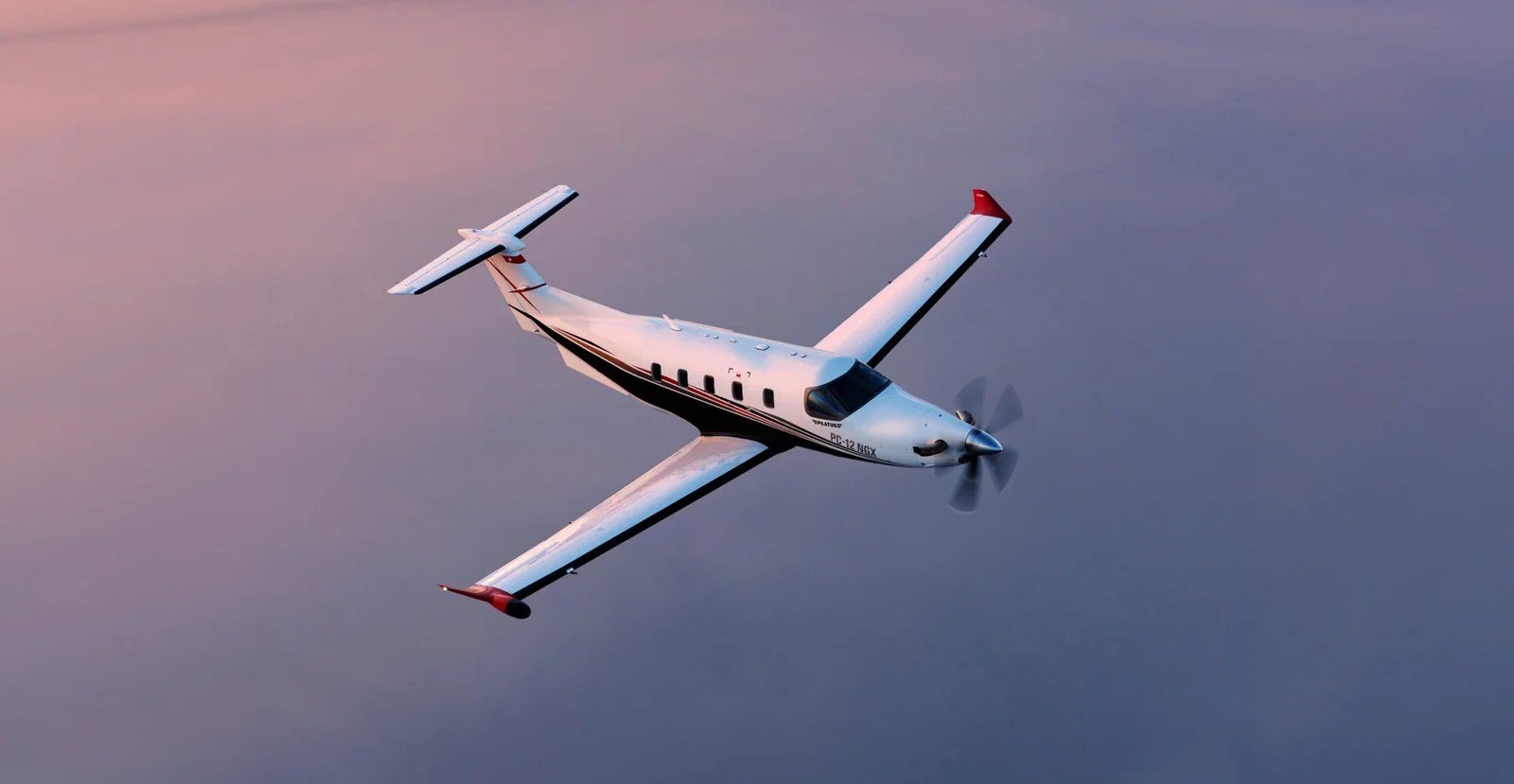
The Pilatus PC-12 is a single-engine turboprop built in three generations, the legacy aircraft from 1997 to 2007, the NG from 2008 to 2019 and the NGX from 2020 onward, sharing a flat-floor cabin of 356 cubic feet. Every one of them flies with two pilots on a Peak trip, whatever the certification allows.
Requests reach us spelled several ways. PC12 charter, PC-12 charter and Pilatus charter all point at this airplane, and everything below applies to each of them.
Is a single-engine turboprop charter safe?
The PC-12 has a single engine. The honest answer is that engine count is not the variable that decides the outcome of a flight, because operating standards are.
Every PC-12 trip Peak books flies with two qualified pilots, even though the airplane is certified for one. That is company policy rather than a regulation, and it is the same policy applied to every aircraft we source. On a charter carrying somebody else’s family into mountain terrain, a second trained pilot is the cheapest redundancy available.
Before an operator appears on one of my quotes it clears an Operator Vetting File: safety rating verified, an Additional Insured Certificate of Insurance on file, the D085 operations specification listing the tails authorized under their Part 135 certificate, and a W9. That check happens once, at company level, before any client boards that operator’s aircraft.
Every individual flight then gets a Total Flight Review within 24 hours of departure. That is our own in-house review, not a report we buy.
A Wyvern PASS or an ARGUS TripCHEQ on the assigned crew is one input to it, alongside weather at origin, destination and enroute, Temporary Flight Restrictions, NOTAMs, catering and ground transport. Green flies. Red never flies.
The type itself has spent roughly three decades in service with air ambulance operators, government fleets and corporate flight departments. Those are organisations that price risk for a living, and they did not choose this airplane by accident.
How much does a Pilatus PC-12 charter cost?
The trip total first, because on turboprops it explains more than a rate does.
What a real booked PC-12 trip cost, end to end
From our booking records, a late August 2026 Bozeman to Cheyenne round trip flew as two legs totalling 3 hours 6 minutes of flying, so about an hour and a half each way, and came to $14,250 all in. Crew and fees are inside that number, with nothing arriving afterwards.
Published rates for the PC-12 run around $2,100 per hour (Paramount Business Jets). Put that beside $14,250 and the arithmetic looks off until you know what an hourly rate covers.
An operator’s daily minimum is the least it will bill for any day it dedicates an airplane and crew to you, flown or not. A trip price carries that minimum, the repositioning flight that brings the aircraft to where you start, and federal excise tax. An hourly rate carries none of them. The shorter the trip, the wider the gap gets, because those fixed pieces spread across fewer airborne hours.
Two things move a PC-12 quote more than most people expect, and neither is on a spec sheet. One is where the airplane already is. The other is how much notice you give. A routing booked three weeks out against an aircraft that was repositioning anyway prices differently from the same routing booked on two days’ notice.
So compare finished trip quotes rather than hourly rates, on your city pair and your date. That is also how the King Air charter guide reads its numbers, and the turboprop vs light jet comparison does the same across our whole book.
Which crossover band does a PC-12 sit in?
This page used to point at our King Air page for a two-hour rule. That rule was too clean and it has been retired, so here is the version that replaced it.
The crossover runs in three overlapping bands: under about two flight hours per leg a turboprop usually wins, two to three hours favours a very light jet, and past three hours the answer is a light, midsize, super-midsize, heavy or ultra-long-range jet chosen by passenger count and distance rather than by the clock. The bands overlap deliberately. Near the two and three hour marks either class is defensible, and the passenger and bag count usually decides first.
The bottom band is where this airplane lives. The PC-12 is at its best on legs under about two hours, and nothing about the new phrasing changes that.
Two details matter when you apply it. Flight time is per leg, not per trip, so the Cheyenne round trip above is two legs of roughly ninety minutes rather than one three-hour flight, and it sits in the turboprop band despite the total. And a very light jet tops out around four cabin seats, so a party of six or seven stays on a turboprop no matter how short the leg is.
Can a PC-12 land on short or unpaved runways?
Two claims get made about this airplane, and only one of them survives contact with our booking policy.
The one that holds is runway. A short runway that rules a jet out entirely, and that makes some twin turboprops cautious, is ordinary work for this type, so in the Mountain West the airplane parks fifteen minutes from your meeting instead of an hour out. Kalispell, Jackson, Cody, Idaho Falls, Salt Lake and Denver’s satellite fields are all legs of forty minutes to two hours from Bozeman.
The cargo door is the other genuine one. The aft door takes gear that defeats a jet baggage hold: bikes, rafts, gun cases, a full family’s worth of ski equipment. Combined with a flat floor of about 356 cubic feet at seated height, it loads like a vehicle rather than a locker.
The claim that does not survive is unpaved strips. The airplane is capable of them.
Peak does not book them. Unpaved operations sit outside our safety parameters for every aircraft we source, so we work small paved airports with an FBO and ground services. If a page sells you grass and dirt access, ask whether the broker will actually place you on it.
Heat and elevation deserve the same honesty. Summer afternoons at high fields cut what any aircraft can lift, and while the PC-12 handles density altitude well for its class, a short high field on a hot afternoon is a morning departure.
How many passengers does a PC-12 hold?
Seven to eight in an executive cabin. That is the figure this page now uses everywhere, and it is a correction.
Older copy here said six to nine, and nine is a commuter number. It assumes a high-density layout flown by a single pilot, which is a different business from executive charter and not something we book. The cabin measures 16 feet 10 inches long and 356 cubic feet, unchanged between the NG and the NGX, and seven or eight people with real luggage is what fits in it comfortably.
Six is where it feels easy. Eight with full ski bags is where I start asking what else is in the trip before I promise anything.
PC-12 versus NG versus NGX: what actually changed
Three generations, and only one of the steps is one a passenger feels.
The legacy aircraft ran from 1997 to 2007. The NG arrived in 2008 and is the real step: a modern flight deck, a better cabin, and the version most charter fleets standardised on. The NGX followed in 2020 with autothrottle, windows about ten percent larger, and better seats.
| Generation | Years | Cabin | What changed for a passenger |
|---|---|---|---|
| PC-12 legacy | 1997 to 2007 | Flat floor, 356 cu ft | The original cabin and flight deck |
| PC-12 NG | 2008 to 2019 | 16 ft 10 in, 356 cu ft | The step most passengers notice, modern deck and cabin |
| PC-12 NGX | 2020 onward | 16 ft 10 in, 356 cu ft | Autothrottle, windows about ten percent larger, better seats |
Ask for a Pilatus PC-12 NGX and you are asking for the 2020 onward build specifically, which is worth naming because most fleets mix generations. Cabin dimensions are identical from the NG to the NGX. Ask which generation is on your quote, because on a ninety-minute leg the honest answer is that the NGX buys you nicer windows and seats rather than a different trip.
When a PC-12 is the wrong answer
Three cases, and I would rather say them here than after you have paid.
Long legs. At roughly 285 knots, a mission past about two hours a leg starts favouring a very light jet and then a light jet, on time first and eventually on money. Published range of about 1,845 nautical miles covers most of the western United States nonstop from Bozeman, but range and sensible mission length are not the same question. The Phenom 300 guide picks up where this airplane leaves off.
Large groups with substantial baggage into paved fields. A King Air 200 or B200 brings twin-engine climb performance and deeper charter availability for that shape of trip, and the seat count runs six to seven in a 200 or B200, and seven to eight in a 350.
Weather-critical schedules into serious terrain. When that is the honest answer you will hear it from us before you book rather than after. Where every class sits relative to the others is laid out in the what size private jet guide.
Common questions about a Pilatus PC-12 charter
How much does a Pilatus PC-12 charter cost per hour?
Published rates run around $2,100 per hour (Paramount Business Jets). Finished trip totals are the more useful figure: a booked Bozeman to Cheyenne round trip in late August 2026 flew two legs totalling 3 hours 6 minutes and came to $14,250 with crew and fees included. A trip price carries repositioning, the operator’s daily minimum and federal excise tax, and an hourly rate carries none of those.
How many passengers does a PC-12 seat?
Seven to eight passengers in an executive cabin, excluding the two pilots. Higher figures published elsewhere, nine or ten, describe high-density commuter layouts flown single pilot rather than executive charter cabins. The flat-floor cabin measures 16 feet 10 inches long and about 356 cubic feet, at seated height rather than stand-up, and an aft cargo door takes bulky items that will not fit a jet baggage hold.
Is the PC-12 safe with only one engine?
Safety is set by operating standards rather than engine count. Peak Aviation Solutions books every PC-12 with two qualified pilots despite single-pilot certification, clears each operator through an Operator Vetting File before quoting, and runs a Total Flight Review in house within 24 hours of every departure. The type has spent roughly three decades in service with air ambulance operators, government fleets and corporate flight departments.
How far can a PC-12 fly?
Published range is about 1,845 nautical miles at roughly 285 knots, which covers most of the western United States nonstop from Bozeman. Sensible mission length is a separate question from maximum range. The airplane is at its best on legs under about two hours, and past that a very light jet or a light jet is generally quicker and often no more expensive once the extra hours are counted.
Can a PC-12 land on grass or dirt strips?
The aircraft is capable of unpaved operations. Peak Aviation Solutions does not book them. Unpaved operations sit outside the safety parameters applied to every aircraft Peak sources, so trips are placed into small paved airports with an FBO and ground services. The runway advantage that does apply is length: the PC-12 uses short paved fields that jets cannot, which often means landing much closer to the destination.
Should you book a PC-12 or a King Air?
The PC-12 leads on short-field access, cargo door flexibility and range from a single cabin. The King Air brings twin-engine climb performance, deeper charter availability, and a seat count of six to seven in a 200 or B200 and seven to eight in a 350, against seven to eight in the PC-12. Both are held to the same operator vetting and flight review standards, so the sensible move is to quote both for your dates.
Where this airplane earns its place
Short legs, small paved fields, real luggage, an honest weather conversation. That is most of the flying people actually do out here, and on those trips a Pilatus PC-12 charter is not a compromise on the jet you thought you wanted. It is the airplane that skips the long drive after landing at the big airport an hour away.
Read the quote as a trip total, ask where the aircraft is coming from, give the real head count, and name the airport rather than the city. Those four habits will move your number more than any published hourly rate on the internet, including the one on this page.
Get a PC-12 quote priced against the alternatives
Send the routing with an honest passenger and bag count, and it comes back priced against a King Air and a light jet on the same dates, with the crossover bands applied to your actual legs, the runway and density altitude answers checked for your actual destination, the operator already through its vetting file, and the Total Flight Review scheduled.
Pay per trip. No membership, no card, no deposit held with us.
Request a quote or call the charter desk at (406) 296-3256. The Peak app carries the empty leg board and quotes live.