

Pet-Friendly Charter Guides · 9 min read
Home / Pet-Friendly Charter Guides / Private Jet Travel With a Dog
By Pat Sinnott, Founder of Peak Aviation Solutions. He holds a commercial pilot certificate (multi-engine, instrument) and a BS in Flight Operations and Aviation Management, has spent 21 years in aviation, and is a member of NBAA.
Last updated: November 3, 2026
A private jet gets your dog into the cabin. It doesn't get your dog past the border, so private jet travel with a dog starts with paperwork. Hawaii, Mexico and Canada each have their own entry rules, and the U.S. has its own for bringing your dog home. Miss one form and the dog may not get off the airplane, or back into the country.
Quick answer: Private jet travel with a dog follows the same entry rules as any other way of traveling. Hawaii requires a microchip, two rabies shots, a blood test and early paperwork. Mexico requires a screwworm certificate for dogs. Canada requires a rabies certificate. Every dog returning to the U.S. needs a microchip, must be 6 months or older, and needs a CDC Dog Import Form.
Rules here are current as of November 3, 2026. Pet entry rules changed several times in 2024 to 2026, so confirm them with the official sources linked below within a week of travel.
The rules at a glance
| Destination | What your dog needs | Start planning |
|---|---|---|
| Hawaii | Microchip, 2 rabies vaccinations, FAVN blood test, 30-day wait, documents filed before arrival | 4 months or more |
| Mexico | Screwworm inspection certificate (from Aug 3, 2026), plus SENASICA inspection on arrival | 2 to 4 weeks |
| Canada | Valid rabies vaccination certificate for dogs 3 months and older | 2 weeks |
| Back into the U.S. | Microchip, 6 months or older, CDC Dog Import Form receipt; from Mexico, a screwworm-freedom certificate | Before you leave |
Sources: Hawaii Department of Agriculture; USDA APHIS; Universal Weather and Aviation; CFIA via AKC; CDC via AKC, all linked below.
Private jet travel with a dog to Hawaii
Hawaii is rabies-free and works hard to stay that way. Hawaii is a domestic trip, but for your dog it's the hardest one on this list.
Hawaii's Direct Airport Release is the program that lets a qualifying dog go home with you from the airport instead of entering quarantine. To qualify, the Hawaii Department of Agriculture requires (HDOA; HDOA Checklist 1):
- A working microchip. If it can't be scanned on arrival, the dog goes to quarantine.
- Two rabies vaccinations.
- An FAVN rabies blood test, followed by a 30-day waiting period before arrival.
- The Dog and Cat Import Form (AQS-279) and documents, received at least 10 days before arriving in Honolulu, or about 30 days before a neighbor-island arrival.
- Fees: $185 per pet for Direct Airport Release in Honolulu, or $165 for a Neighbor Island Inspection Permit to land directly at Kona, Kahului or Lihue (fees per PetRelocation's summary of HDOA rules).
Miss a requirement and the dog can face up to 120 days of quarantine.
For a private flight, there's one more step: the arrival time has to fall within the inspectors' hours at the airport you're landing at. We plan the departure around it. More on the flight itself in our guide to a private jet to Hawaii, which also covers the USDA bag check on the way home.
Mexico: the screwworm rules
Mexico used to be easy. Since late 2019, dogs and cats from the U.S. haven't needed a health certificate, just an inspection on arrival (USDA APHIS). That changed in 2026 for dogs, because of the New World screwworm.
Going to Mexico: as of August 3, 2026, dogs need a New World screwworm inspection certificate for pet dogs, signed by a USDA-accredited veterinarian no more than five days before the dog arrives in Mexico (AVMA; USDA APHIS bulletin; Universal Weather and Aviation). Cats don't need it going south, but the AVMA notes that cats coming back from Mexico need the screwworm certificate too.
On arrival, SENASICA, Mexico's agricultural health agency, inspects the pet. For business aviation arrivals, Universal Weather and Aviation advises carrying a current vet health certificate and rabies certificate and sending copies to the handler before arrival.
Coming home from Mexico: this is the part that catches people. Every dog entering the U.S. from Mexico, including U.S. dogs that were just on vacation, needs a screwworm-freedom certificate from an authorized veterinarian in Mexico, after an inspection within five days of travel (Universal Weather and Aviation; KJZZ).
So a dog trip to Cabo has three steps:
- A U.S. vet inspection and certificate within five days before you land in Mexico.
- A Mexican vet inspection and certificate within five days before you fly home.
- The CDC Dog Import Form, below.
We line up the authorized vet in Mexico before you leave. Trip details are in our guides to a private jet to Cabo and Cancun.
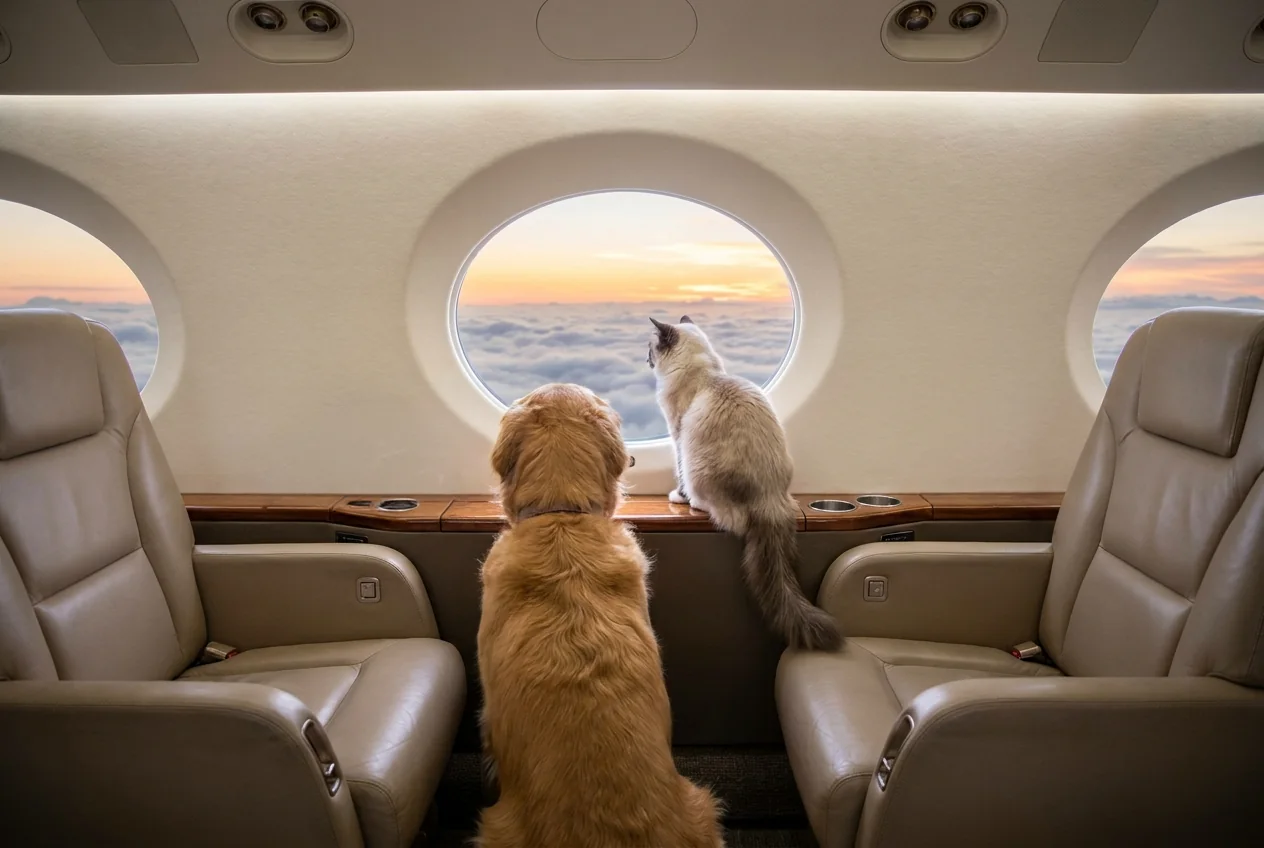
Canada
Canada is simpler. For a pet dog 3 months or older coming from the U.S., you need a valid rabies vaccination certificate from a licensed veterinarian (CFIA requirements via Daily Hive). The dog should appear healthy and travel humanely.
Canada doesn't require a microchip, but the U.S. does when you come back. Get the chip before the trip.
Coming home: the CDC Dog Import Form
Since August 1, 2024, every dog entering the U.S., including U.S. dogs returning from a trip, must be at least six months old, have a microchip, appear healthy and arrive with a CDC Dog Import Form receipt (CDC rule summary via AKC).
For dogs that have only been in low-risk countries such as Canada and Mexico in the past six months:
- The form is online, free and takes a few minutes.
- Each dog needs its own form.
- The receipt is valid for six months and multiple entries.
- You can show it on your phone.
Dogs that have been in a high-risk country for rabies in the past six months face much stricter rules. Tell us early if that applies.
On a private flight, customs officers check the dog at the arrival airport along with everyone's passports. For how the customs stop works on the way home, see do you need a passport on a private jet.
The Caribbean and beyond
Each Caribbean country sets its own pet rules, often including an import permit and a vet certificate dated within days of travel. Some are quick, others take weeks. Start at least 30 days out and send us the destination first, so we can check the rules with the local handler.
How we plan an international dog trip
International trips need more lead time than domestic ones, and pets add to it.
"International trips always take more planning than domestic ones. Between customs, aircraft handling and arrival slots, locking in every detail simply takes longer."
Pat Sinnott
We've flown dogs into both Mexico and Canada. In our experience, the core document is a letter from your vet showing the dog's vaccinations are current. On top of that comes whatever the destination has added lately, like Mexico's 2026 screwworm certificate, so we check the official sources before every trip.
Our checklist for every international dog trip:
- Confirm the operator accepts the dog, in writing.
- Check the dog's age and microchip against the U.S. return rules.
- Map the destination's entry rules and every certificate's timing window.
- Book the vet visits at both ends inside those windows.
- Fill out the CDC Dog Import Form before departure.
- Send copies of every document to the handler at the arrival airport.
For the big picture, start with pet-friendly private jet charter. For dogs in particular, see our guide to a private jet for dogs.
Questions about private jet travel with a dog
Can I take my dog to Hawaii on a private jet?
Yes. Private jet travel with a dog to Hawaii works, but the dog must meet Hawaii's rabies rules to avoid quarantine. That means a working microchip, two rabies vaccinations, an FAVN blood test with a 30-day wait, and documents received before arrival. Direct Airport Release costs $185 per pet in Honolulu, and a Neighbor Island Inspection Permit costs $165. Dogs that do not qualify can face up to 120 days of quarantine.
What does my dog need to fly private to Mexico?
As of August 3, 2026, dogs flying from the U.S. to Mexico need a New World screwworm inspection certificate from a USDA-accredited veterinarian, and SENASICA inspects pets on arrival. To return to the U.S., the dog needs a screwworm-freedom certificate from an authorized veterinarian in Mexico within five days of travel, plus a CDC Dog Import Form receipt.
What does my dog need to fly private to Canada?
A dog 3 months or older entering Canada from the U.S. needs a valid rabies vaccination certificate from a licensed veterinarian and must appear healthy. Canada does not require a microchip, but the U.S. does for the return trip, along with a minimum age of six months and a CDC Dog Import Form receipt.
Does my dog need a CDC form to come back to the U.S.?
Yes. Since August 1, 2024, every dog entering the U.S., including U.S. dogs returning from abroad, must be at least six months old, be microchipped, appear healthy and have a CDC Dog Import Form receipt. For dogs that have only been in low-risk countries such as Canada or Mexico, the free online form is valid for six months.
How far ahead should I plan international travel with a dog?
At least 30 days for most trips, and four months or more for Hawaii, because of the blood test and 30-day waiting period. Mexico's screwworm certificates must be issued within a few days of travel in each direction, so vet appointments need to be booked around the flight dates.
The short version
In private jet travel with a dog, the jet is the easy part. For Hawaii, start months ahead. For Mexico, plan vet visits within days of each flight. For Canada, bring the rabies certificate. And for any trip abroad, make sure your dog can get back into the U.S.: microchip, six months old, CDC form.
Taking your dog abroad?
Tell us where you're going and about your dog. We'll map every certificate and its timing window, line up the vet at the other end, and plan the flight around inspection hours. On the call, I'll walk through the exact paperwork for your destination.
Picture clearing customs with your dog at your side, every form already in order.
Book a call with Pat to plan an international trip with your dog. Already have dates? You can also request a quote.
Send the Trip. Get Real Options.
Real aircraft near your departure, all-in pricing, and the Operator Vetting File on every option. Pay per trip, no membership.