


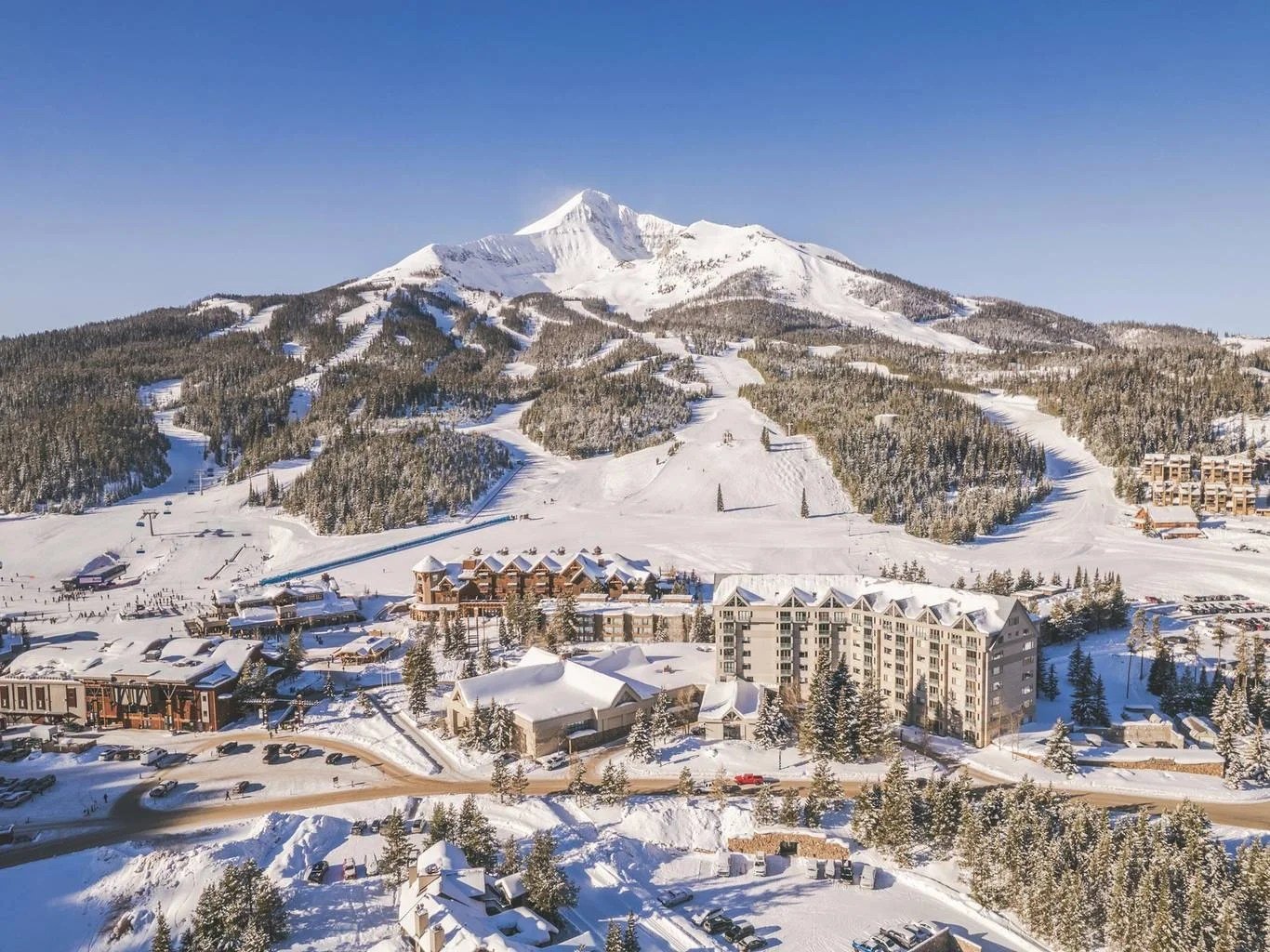
Ski Season Charter Guides · 12 min read
Home / Ski Season Charter Guides / Ski Resorts Close to Airports
By Pat Sinnott, Founder, Peak Aviation Solutions (Bozeman, Montana). Pat is a commercial pilot rated for multi-engine and instrument flying, holds a BS in Flight Operations and Aviation Management, and has 21 years in aviation. NBAA member.
Last updated: November 3, 2026
The airplane was on approach to Jackson Hole, and the weather was below minimums. The crew turned for Driggs, Idaho, a short hop away on the other side of the Tetons. The passengers weren’t surprised. We’d told them the day before that a diversion was possible, and an SUV was already waiting at Driggs to take them over Teton Pass.
That’s the part most lists of ski resorts close to airports leave out. Being close to the runway is one thing. Getting onto it in a February storm is another.
This guide ranks the big western ski airports the way a private flyer actually experiences them. Two things matter. How far is the runway from the lifts, and how often does winter get in the way?
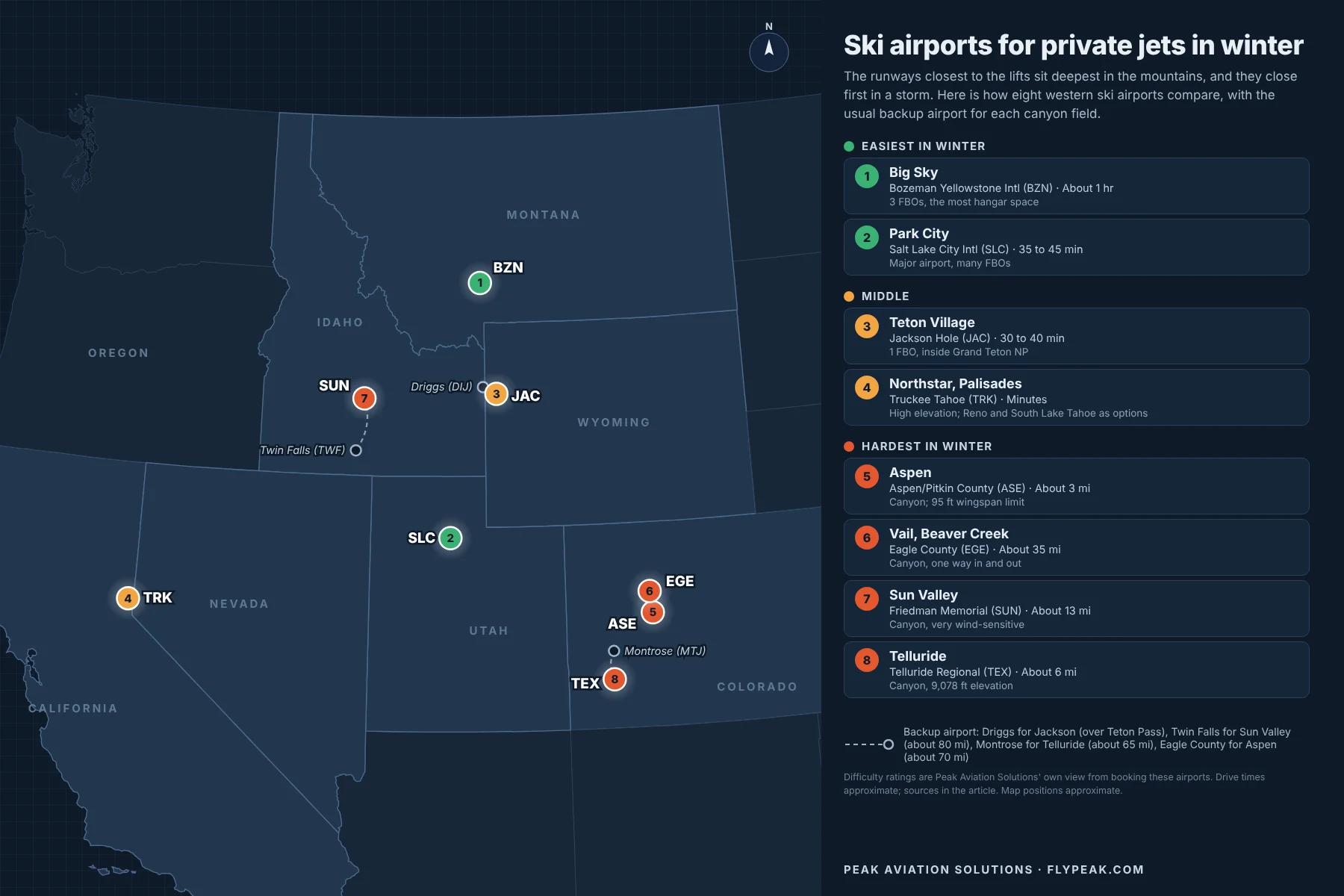
Quick answer: The ski resorts closest to airports include Aspen (about 3 miles from Aspen/Pitkin County), Telluride (about 6 miles) and Sun Valley (13 miles from Hailey). Those are also among the hardest to fly into in winter, because they sit in canyons with essentially one way in and one way out. For reliability, Bozeman (for Big Sky) and Salt Lake City (for Park City) are the easiest, with more facilities and more FBOs (Peak Aviation Solutions, 2026).
Ski resorts close to airports, ranked for private flyers
| Ski destination | Private jet airport | To the resort | Winter difficulty (Peak’s view) |
|---|---|---|---|
| Aspen | Aspen/Pitkin County (ASE) | About 3 miles | Hardest tier: canyon, one way in and out |
| Telluride | Telluride Regional (TEX) | About 6 miles | Hardest tier: canyon, 9,078 ft elevation |
| Sun Valley | Friedman Memorial (SUN), Hailey | About 13 miles | Hardest tier: canyon, very wind-sensitive |
| Vail and Beaver Creek | Eagle County Regional (EGE) | About 35 miles to Vail, 28 to Beaver Creek | Hardest tier: canyon, one way in and out |
| Jackson Hole | Jackson Hole (JAC) | About 30 to 40 minutes to Teton Village | Middle: mostly one way in and out, one FBO |
| Park City | Salt Lake City International (SLC) | About 37 miles, 35 to 45 minutes | Easiest tier: big airport, many facilities |
| Big Sky | Bozeman Yellowstone International (BZN) | About 1 hour to Town Center | Easiest tier: three FBOs, more hangar space |
| Lake Tahoe | Truckee Tahoe (TRK), South Lake Tahoe (TVL) or Reno-Tahoe (RNO) | Minutes from Northstar via Truckee; about an hour from Reno to Palisades | Middle: high elevation, but several airports to choose from |
Sources: Friedman Memorial Airport; Aspen Chamber; Blue Sky Limo, Colorado airports for Eagle County and Telluride; Jackson Hole Central Reservations; All Seasons Resort Lodging for Salt Lake to Park City; Ridebooker for Reno to Palisades, 2026. Telluride elevation from FAA airport data. Difficulty ratings are Peak Aviation Solutions’ own, from booking these airports.
The pattern is hard to miss. The closer the runway sits to the lifts, the deeper in the mountains it usually is.
What makes a ski airport hard in winter
A "one way in, one way out" airport is one where the surrounding terrain lets aircraft approach and depart mostly from a single direction. Wind, low cloud or snow on that one path can close the door entirely.
Aspen, Eagle, Hailey and Telluride all fit that description. In Jackson, most traffic works the same way. A few things follow from it:
- Wind decides. At Sun Valley, aircraft typically can’t land with a tailwind above about 10 knots, in my experience. It’s a very sensitive airport.
- Weather decides faster. When cloud sits low in a canyon, there’s no easy second approach from another side.
- Size limits apply. Aspen restricts aircraft to a 95-foot wingspan (FAA airport data), which rules out some larger jets.
- Fewer services. Smaller mountain airports often have one FBO and limited hangar space.
- Daylight and curfews. Many mountain airports aren’t places to land at night, and several limit night operations outright. Telluride is closed from 9 p.m. to 6 a.m. and is widely treated as a daylight-only airport (FAA airport remarks). Aspen closes from 11 p.m. to 7 a.m. (Aspen/Pitkin County Airport). Jackson Hole asks private aircraft not to operate from 9:30 p.m. to 7 a.m. (Jackson Hole Airport). Many operators also set their own daylight-only rules for mountain fields, for safety.
- Elevation. Telluride Regional sits at 9,078 feet. Thinner air at high airports lengthens takeoff and landing distances, which can limit how much an aircraft carries, including passengers, fuel and ski gear.
Sun Valley’s challenges are well documented. The FAA has backed replacing Friedman Memorial, in part because of high winter diversion rates (AVweb).
None of this makes these airports unsafe. Not at all. It makes them airports where the plan needs a backup, and where the backup needs a car.
Weather minimums, explained
Weather minimums are the lowest cloud ceiling and visibility at which an aircraft is allowed to fly a given approach or departure. If the weather at the airport is below minimums, the crew cannot land there and must hold or divert to an alternate airport.
Minimums vary by airport, by approach and by operator. Mountain airports often have higher minimums than flat-country airports, because the terrain leaves less room for error.
The decision to continue or divert belongs to the flight crew. Our job is to make sure that when they make it, the passengers already have a plan.
Backup airports for the canyon resorts
Every hard airport on this list has a usual alternate. Know it before you go, along with the drive.
| Intended airport | Common alternate | Drive from the alternate |
|---|---|---|
| Aspen (ASE) | Eagle County (EGE) | About 70 miles, roughly 1 hour 30 minutes to Aspen |
| Telluride (TEX) | Montrose (MTJ) | About 65 miles to Telluride |
| Sun Valley (SUN) | Twin Falls (TWF), Gooding or Jerome | About 80 miles from Twin Falls to Hailey |
| Jackson Hole (JAC) | Driggs, Idaho (DIJ) | Over Teton Pass into Jackson |
Sources: Aspen Chamber for Eagle County to Aspen; Colorado ground-transport guides for Montrose to Telluride; press coverage of Friedman Memorial for Twin Falls; Peak Aviation Solutions diversions for Driggs, Gooding and Jerome.
An alternate that’s 70 or 80 miles away still beats a night in a hotel on the wrong side of the mountains. It’s also why ski resorts near airports with big, open approaches, like Park City and Big Sky, stay so popular with groups that can’t afford a lost day.
What happens when a private jet can’t land at a ski airport
First, the honest context: diversions are rare. Most of the time we can see the weather window coming. So we work with the operator and move the departure, earlier or later, around the snow or whatever hazard is in the forecast. That usually solves it.
When it doesn’t, the aircraft diverts to a nearby airport and the trip continues by car. Two real examples from our own trips:
Jackson Hole to Driggs. A couple of times last winter, weather at Jackson was below minimums on arrival. We knew the night before, so we called ground transportation companies in Driggs, Idaho and had one on standby, waiting for our call. When the aircraft diverted to Driggs, the SUV was there right away for the drive over Teton Pass into Jackson Hole.
Sun Valley to Gooding, Jerome or Twin Falls. At Sun Valley we’ve had passengers divert to Gooding Municipal, and also to Jerome or Twin Falls. Twin Falls is about 80 miles south of Hailey, so it’s a real drive, but it’s a safe one.
In both cases, the aircraft tried the intended airport first. The call was made on approach. And in both cases, the passengers knew it could happen before they ever left home.
"It’s always preferred that they land at their intended destination, but safety is always going to be our number one priority."
Pat Sinnott
The Day-Before Diversion Call
The Day-Before Diversion Call is Peak Aviation Solutions’ practice of telling passengers, the day before a winter flight to a sensitive mountain airport, that a diversion is possible, which alternate is likely, and how they’ll get from there to the resort.
How it works:
- Watch the forecast. For canyon airports, the weather gets checked as the trip approaches, not just on the day.
- Call the day before. If a diversion looks possible, the passengers hear it from us, with the likely alternate named.
- Stage the ground leg. A vehicle is lined up for the alternate, so a diversion costs time, not a stranded evening.
- Decide on the day. The final go or no-go waits for the day of departure, with the crew making the safety call.
A diversion handled this way is an inconvenience. A diversion nobody mentioned is a bad trip.
Which ski destinations private flyers book most
Outside Montana, the ski requests we see most are Park City, Jackson Hole, Lake Tahoe and Aspen. They split neatly by airport type:
- Park City is the easy one. Salt Lake City is a large airport about 35 to 45 minutes away, with lots of facilities and FBOs. See private jet charter to Park City.
- Jackson Hole puts you close, but through a single-FBO airport inside Grand Teton National Park. See private jet charter to Jackson Hole.
- Lake Tahoe sits in the middle tier. Truckee sits high, at 5,904 feet (FAA airport data). But Tahoe has options: Truckee for the North Shore resorts, South Lake Tahoe for the south end, and Reno as the larger airport. See private jet charter to Lake Tahoe.
- Aspen is the closest runway in this guide and one of the toughest. See private jet charter to Aspen.
Vail and Beaver Creek go through Eagle County, about 35 miles from Vail. See private jet charter to Vail.
Montana: the easy airport and a big mountain
Bozeman is our home airport. We see a steady stream of skiers flying in for the Yellowstone Club, Spanish Peaks and Big Sky Resort. Staying in Bozeman? You get a bonus: Bridger Bowl, about 16 miles and 25 minutes from town (Visit Bozeman).
BZN is why Big Sky belongs in the easy tier. It has three FBOs, more hangar space than most ski airports, and room to work around a storm. The trade is the drive: about an hour to Big Sky Town Center through Gallatin Canyon.
Our Big Sky guides go deeper:
- Getting from Bozeman airport to Big Sky: drive times, shuttles and a car at the airplane.
- Private jet deicing cost at Bozeman: what deicing costs and how a hangar avoids it.
- Big Sky vs Jackson Hole: terrain, snow, crowds and which airport is easier.
- Flying with skis on a private jet: which jets fit the gear.
- Big Sky Montana airport guide: Bozeman, Ennis and the Yellowstone Club.
For the flight itself, see private jet charter to Big Sky or Bozeman private jet charter.
How to pick a ski airport by private jet
A short checklist we use on every winter quote:
- Distance to the lifts. Closest isn’t always best if the airport is the first to close.
- Approach and wind sensitivity. Ask how the airport handles a tailwind or low cloud.
- The alternate. Know the backup airport and the drive from it.
- FBOs and hangars. More choice means more room on a holiday weekend.
- Aircraft fit. Wingspan limits, runway length and ski gear all narrow the list.
- Daylight. At canyon airports, plan to land before sunset. A late start from home can mean an arrival the airport or the crew won’t accept.
- Timing. Holiday weeks fill airplanes, hangars and ramps early.
Want this as a one-page checklist? Download the winter ski trip checklist.
Questions about ski resorts close to airports
Which ski resorts are closest to an airport?
Among ski resorts close to airports, Aspen is nearest: about 3 miles from Aspen/Pitkin County Airport. Telluride is about 6 miles from Telluride Regional, and Sun Valley about 13 miles from Friedman Memorial in Hailey. Vail is about 35 miles from Eagle County Regional, and Park City is about 37 miles from Salt Lake City International.
What is the easiest ski airport to fly into by private jet?
In winter, larger airports in open valleys are usually easiest. Peak Aviation Solutions ranks Bozeman, for Big Sky, and Salt Lake City, for Park City, as the easiest of the major western ski airports. Both have more facilities and FBOs and are less sensitive to wind and low cloud than canyon airports.
Why are Aspen, Vail, Sun Valley and Telluride harder to fly into?
Their airports sit in mountain canyons where terrain allows approaches and departures mostly from one direction. Wind, low cloud or snow on that path can stop arrivals. Some add limits of their own, such as Aspen’s 95-foot wingspan restriction or Sun Valley’s sensitivity to tailwinds.
What are weather minimums?
Weather minimums are the lowest cloud ceiling and visibility at which an aircraft may fly a specific approach or departure. They vary by airport, procedure and operator, and are often higher at mountain airports. When conditions are below minimums, the crew must hold or divert to an alternate airport.
What happens if a private jet can’t land at a ski airport?
The aircraft diverts to a nearby alternate and passengers finish the trip by car. Common examples are Driggs, Idaho for Jackson Hole, and Gooding, Jerome or Twin Falls for Sun Valley. A good broker warns passengers ahead of time and has ground transport ready at the alternate.
Which ski destinations do private flyers book most?
Outside Montana, Peak Aviation Solutions sees the most ski requests for Park City, Jackson Hole, Lake Tahoe and Aspen. Demand peaks around Christmas, Martin Luther King Jr. Day and Presidents’ Day, when aircraft, hangars and ramp space at mountain airports fill early.
The short version
Ski resorts close to airports are often the hardest to fly into, because the runway shares a canyon with the weather. Aspen, Eagle, Sun Valley and Telluride reward a backup plan; Bozeman and Salt Lake reward almost anyone. Whichever you choose, know the alternate before you leave.
Planning a ski trip this season?
Tell us where you want to ski. We’ll weigh the airport against the resort.
We’ll check that the aircraft fits both the airport and the gear. And if the weather might move the plan, you’ll hear from us the day before. One thing we save for the call: which alternates actually make sense for your resort, and how long each drive takes.
Picture a storm closing the canyon, and your SUV already idling at the alternate.
Book a call with Pat about your resort and dates. Already have dates and a head count? You can also request a quote.
Send the Trip. Get Real Options.
Real aircraft near your departure, all-in pricing, and the Operator Vetting File on every option. Pay per trip, no membership.